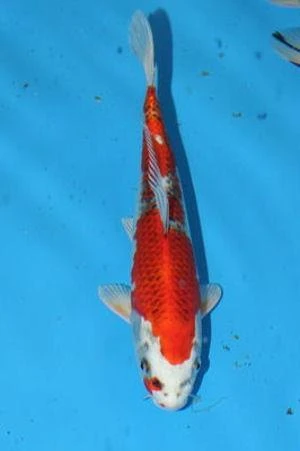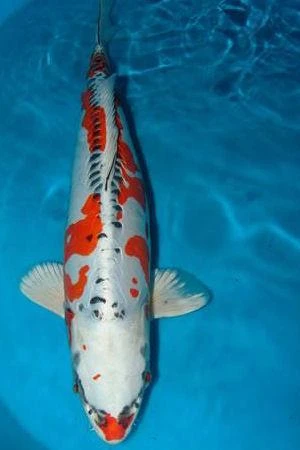
The Kujaku
Family of the Kujaku
Origins:
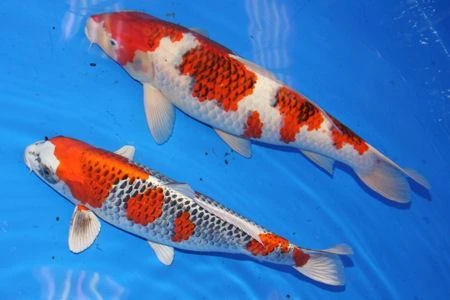
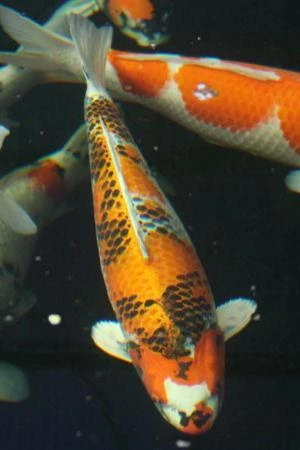
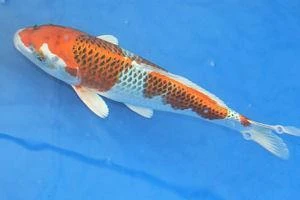
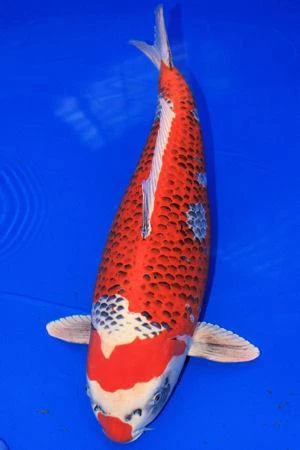
The Kujaku was created in the 1960s by Mr Nishi Hirasawa of Hiranishi Fish Farms, Kujaku means "Paon" (the bird) in Japanese. A Kujaku is a Matsuba Ogon (mainly a Gin Matsuba) with a drawing Hi (Red), Orenji (Orange) or Ki (Jaune), thus the main feature of the Kujaku being that each scale has the characteristic of the brand Ai (Indigo) of Matsuba. At the top, a Goromo, non-metallic variety, below a Kujaku, a metallic variety. Two varieties not to be confused.
The Kujaku exists in Doitsu variety.
How do I recognize a Kujaku with certainty?
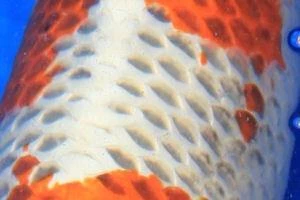
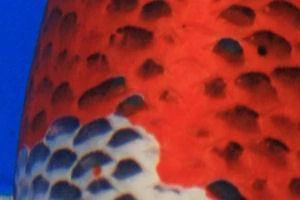
Be careful not to confuse it with a Hariwake that may have the same metallic brilliance with the same colors but without the Matsuba brand on the scales, or with a Goromo or Goshiki that do not have the metallic appearance of the Kujaku. Due to its origins, the Kujacu has a metallic reflection (Ogon), a platinum background color and Hi (Red) marks but which are rather red-orange or even orange yellow. Very important, the scales have the brand Ai (Indigo) of the Matsuba, which gives a cross-linked look to the fish like the Asagi. For the Doitsu Kujaku, be careful that the two rows of scales on the back have a center with the brand AI (Indago) because if there is none, it is a Doitsu Hariwake. It is also necessary to check the absence of very pronounced Sumi marks on pectorals in order not to confuse it with one of the varieties of Kikokuryu.
Item 1:
The background colour is Gin Matsuba. It is a platinum color (Platinum) of metallic (Gin) and not white (Shiroji).
Item 2:
The brands are like those of Kohaku, major Hi brands which, because of the metallic appearance of the fish are not as deep red as Kohaku, but are red-orange.
Item 3:
The scales possess the Indigo brand (Ai) of the Matsuba Important, the marks cover the whole body.
How to judge the quality of a Kujaku?
1. The metallic chandelier must be present throughout the body.
2. The colour of the drawings must be regular but let the Matsuba pattern be seen.
3. The head with or without colour must be clear.
4. The drawings are considered as for a Kohaku.
Varieties and Sub Varieties
The Kujaku The Doitsu Kujaku Kujaku with Hi color pattern.
Variety Doitsu from Kujaku. Notice the drawing Matsuba on the scales of the back that makes them darker. Otherwise, it is a Doitsu Hariwake.