Goromo (Koromo) koi
The Goromo
Goromo family
Origins:
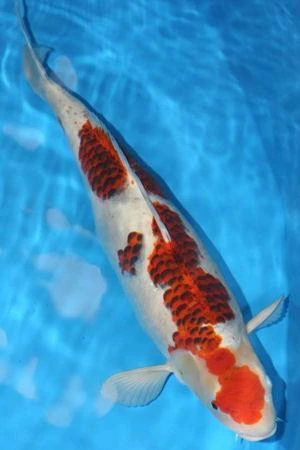
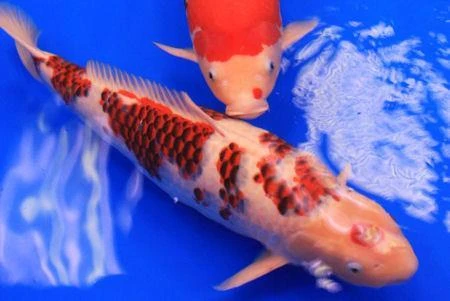
The name Goromo means "Enromé". In fact, Ai Goromo means 'Who wears Indigo clothes'. Goromo have existed since the 1950s. Goromo are the result of the crossing between a Kohaku, a Sanke or a Showa and an Asagi. The crossing of an Asagio with a Kohaku normally gives a Goshiki. One day, when raising Goshiki, there was a koi that had plain white in place of the reticulated Asagi style background, this Asagi-style background remained only located on Hi drawings, which is what we now call the Ai Goromo. The quality of an Ai Goramo is determined by the quality of the Kohaku drawing and the beauty of its Indigo color that covers his Hi drawings. A Kohaku has Hi drawings on its white skin, an Ai Goromo, it's like a Kohaku but it has indigo (Ai) on the edge of each scale that covers the Hi. It's not easy to have a Kohaku with a beautiful drawing, it'll be even more difficult to put indigo on every scale covering the Hi. It is clear that the probability of getting a good Ai Goromo is very low. A very beautiful Goromo.
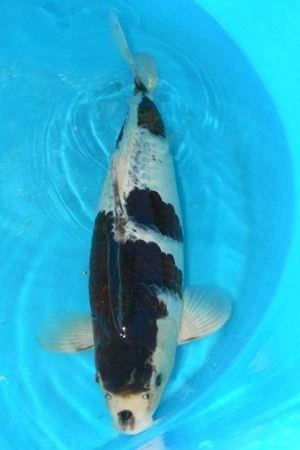
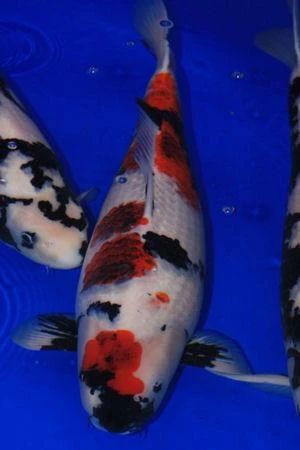
Remembering the origin of Goromo (Asagi + Kohaku), Goromo has white skin, sometimes in fry, there is a koi that seems to be in an intermediate state with darker scales on Shiroji (White), it is a Kage Goromo, it is a very rare variety because it appears in a random way. The Goromo Sanke is the result of the crossing between an Ai Goromo and a Sanke, it has Hi marks covered with cross-linked pattern and Sumi spots spread over the body. The Goromo Showa is the result from the crossing between a Ai Goromi and a Showa, the Hi is rather rusty color with the cross-linking pattern, the Sumi is the dominant color. There is also the Sumi Goromo. The Ai Goromo comes from the Agagi lineage, it usually has the color of the Asagi (Indigo) on the edge of scales that cover the Hi. When the edge of the scales Ai (Indago) is replaced by Sumi (Black), it becomes a Sumi Goramo. The Budo Goromo is a variant of the Sumi Goromo, it is a white Koi with a purple pattern in the shape of a grape cluster, the word Budo means grapes.
How can we recognize a Goromo with certainty?
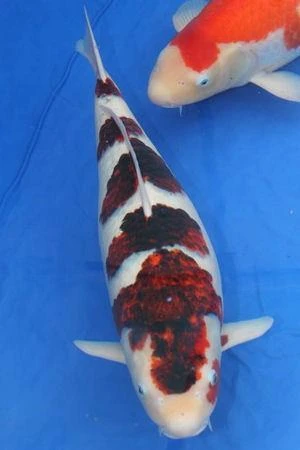
A fish of the Goromo family has a Pattern similar to that of Kohaku, Showa or Sanke. The difference is that Hi marks are covered with scales with a red center and a crown either Ai (Indigo) or Sumi (Black).
Item 1:
The Pattern is the same as that of a Kohaku, a Showa or a Sanke, big Hi brands.
Item 2:
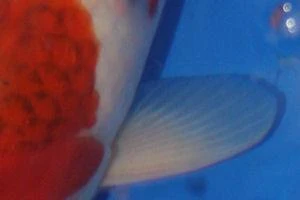
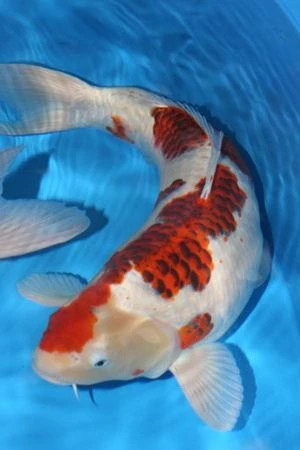
The background colour is white (Shiroji) just like the Kohaku for the Ai, Sumi and Budo Goromo. Pectorals have the same characteristics as basic fish, i.e. Kohaku, Showa or Sanke. They can be white (As here) or have Motoguro as for the Goromo Showa.
Item 3:
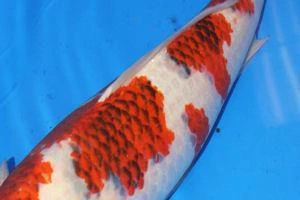
Hi marks are covered with scales giving the same cross-linked design as the Asagi.
Developments:
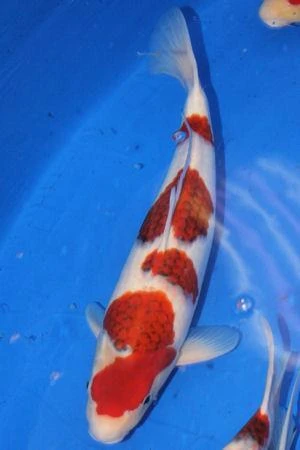
The appearance of the Ai on Hi spots depends on the lineage. Indeed, some Koi lines have Ai spots as soon as they are Tosai. For other lines, it is necessary to wait for the Koi to reach the size of 50 to 60 cm. When the Koi is young, there is not always colorful scales on the Hi, it looks like a Kohaku, a Sanke or a Showa but when it is 2 to 3 years old, the dark edge of the scales begins to appear. It will take 4 to 5 years for the Goromo pattern to cover the entire Hi brands. As previously written, when you raise Kohaku, sometimes the scales on the Hi become darker and darker and it looks like a Kohaku that turns bad. You can be disappointed, don't give up the Koi that you thought was a Kohaku, it may be a Goromo.
How to judge the quality of a Goromo?
1. A Goromo must have a beautiful drawing just like Kohaku, Showa or Sanke.
2. The Shiroji must be very white, without any trace of the Goromo pattern.
3. The cross-linked aspect of the Hi drawing must be well marked and well distributed.
As explained, Goromo and Goshiki share the same origin, sometimes when rearing, we obtain Ai Goromo by raising Goshiki.
In the same way, there are chances of having Goromo Showa during the breeding of Goshiki Showa. The farming of Ai Goromo is not difficult, but it is more difficult to buy because, for example, a Kohaku, when it is tosai, already has its characteristics. An Ai Goramo of the same age is more expensive and the Goromo pattern is still very little developed and at first glance, this fish seems to have a Hi of poor quality, it takes some courage to buy this type of fish when it is young.

Varieties and Sub Varieties
The Budo Goromo The Ai Goromo The Budo Goromo is a variant of the Sumi Goromo, it is a white Koi with a purple pattern in the shape of a grape cluster, the word " Budo" means grapes.
The Ai Goromo has Ai (Indigo) marks on scales covering Hi (red) drawings.
A young Goromo The Goromo Showa When the Goromo is young, the indigo marks on the scales are very little marked. It is a Showa whose Hi brands have the cross-linked appearance of the Goromo.