
Blue algae, red ponds and mortality
Text devoted to proliferations observed during the summer of 2003, according to Gérard Masselot. The clear red boxes provide current clarifications and recommendations.
This summer, more than in previous years, because of the heat, the proliferation of green, blue, red, yellow, brown algae were observed in fresh waters throughout Europe. Risks to human health have sometimes arisen. Those responsible are often cyanobacteria better known as blue algae.
Cyanobacteria, known as blue algae
In the summer of 2003, some fresh water bodies, rivers heated by the sun took on different colours, from green to red, through brown, ochre and blue. Dogs died after bathing in rivers. Are toxins secreted by these algae responsible for these new risks? Cyanophycea are living organisms, which to simplify we will place between bacteria and plants. These organisms do not possess a true nucleus, have no sexual reproduction, are carrying chlorophyll and other pigments (so that these "blue algae" can in colony give various colorations to the water. Cyanophycea are omnipresent, both geographically (latitude) and in a variety of environments (including terrestrial).
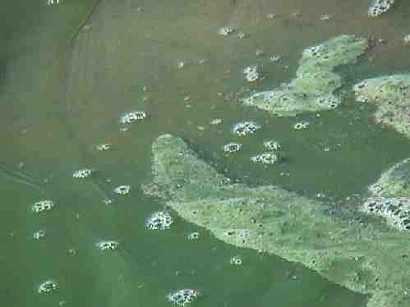
Nitrogen fixation and water colouring
These organisms have other originalities: they are able to fix atmospheric nitrogen, and transform it into ammonium or nitrates. This production of nitrogen assimilable by plants is evidenced, for example, in rice cultivation: a cyanobacteria of the genus Anabaena fixed atmospheric nitrogen, which it transforms into nutrients, at the end of the season cyanobacteria die and release the nutrient salts for rice. Another originality is the coloration of water: the Red Sea owes its name to blooms of cyanobacterials containing one dye (phycoerythrin), the pink flamingos are thanks to another (Spirulina sp.), and the phenomenon of "rougage" of ponds, known as "breeds of Burgundy", has its origin in the proliferation of Planktothrix rubescens.
Toxins and death episodes
A number of species belonging to different genera: Anabaena, Lyngbia, Microcystis, Nodularia, Nostoc, Planktothrix (Oscillatoria), TrichodesmiumIn Australia, 149 people (mostly children) were poisoned in 1979 at Palm Island, Queensland, following water consumption from a reservoir, which was the victim of a cyanobacteria boom Cylindrospermopsis raciborskii. This cyanobacteria was considered a tropical species, but it was found in the United States and France. Other accidents occurred from other cyanobacteries in Brazil (50 deaths), Canada and elsewhere.
Conditions conducive to proliferation
What are the reasons for these "blooms"? There are many (and not everyone agrees against them!). Excess nitrogen and phosphorus are essential. The origin of these nutrients is well known: agriculture, urbanization. The intense light favors this development as well as high temperatures and weak flow. This summer all the conditions were met during the summer of 2003 for the "explosions" of algae!
Oxygen and precautions
The development of algae causes drastic oxygen deficits that can lead to fish mortality. Many questions remain: first, a very partial knowledge of these cyanobacteria, both about species and their biology, ecology and toxic role. The only advice we can give is to avoid letting animals drink coloured water and let them bathe in it. The same applies to humans!
According to Gérard Masselot
Hydrobiologist
Doctor of Science
Ecologist Engineer
Attached to the Museum National d'Histoire Naturelle Paris
Expert at IUCN French Committee (Ecosystem Management)