
The most experienced will notice that there are many elements missing in the diagrams: UV, air pump, skimmer, etc. These diagrams are not representative of 100% reality and are not represented on a scale. They are just there to lighten the mind of a beginner who can imagine the work that will be generated by such or such realization and will make his choice more easily according to his means.
Two methods of filtration must be distinguished: the "pumped" mode and the "gravitary" mode. In this section, you will find explanations in very simplified images of these two principles.
The "pump" mode
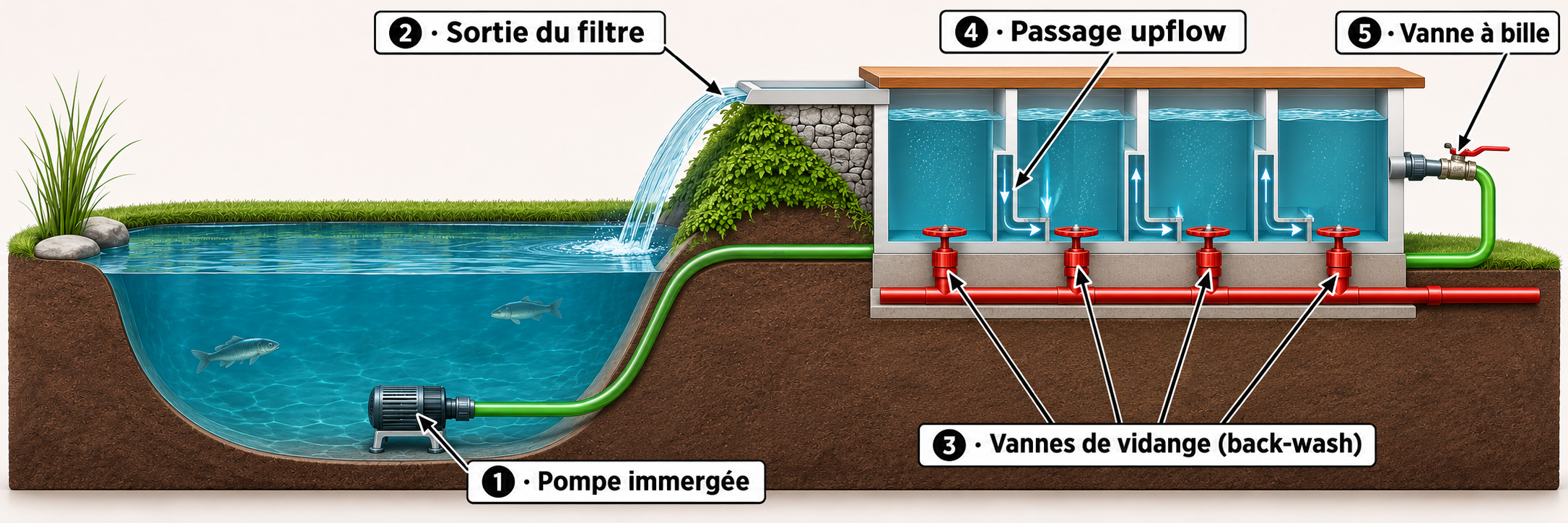
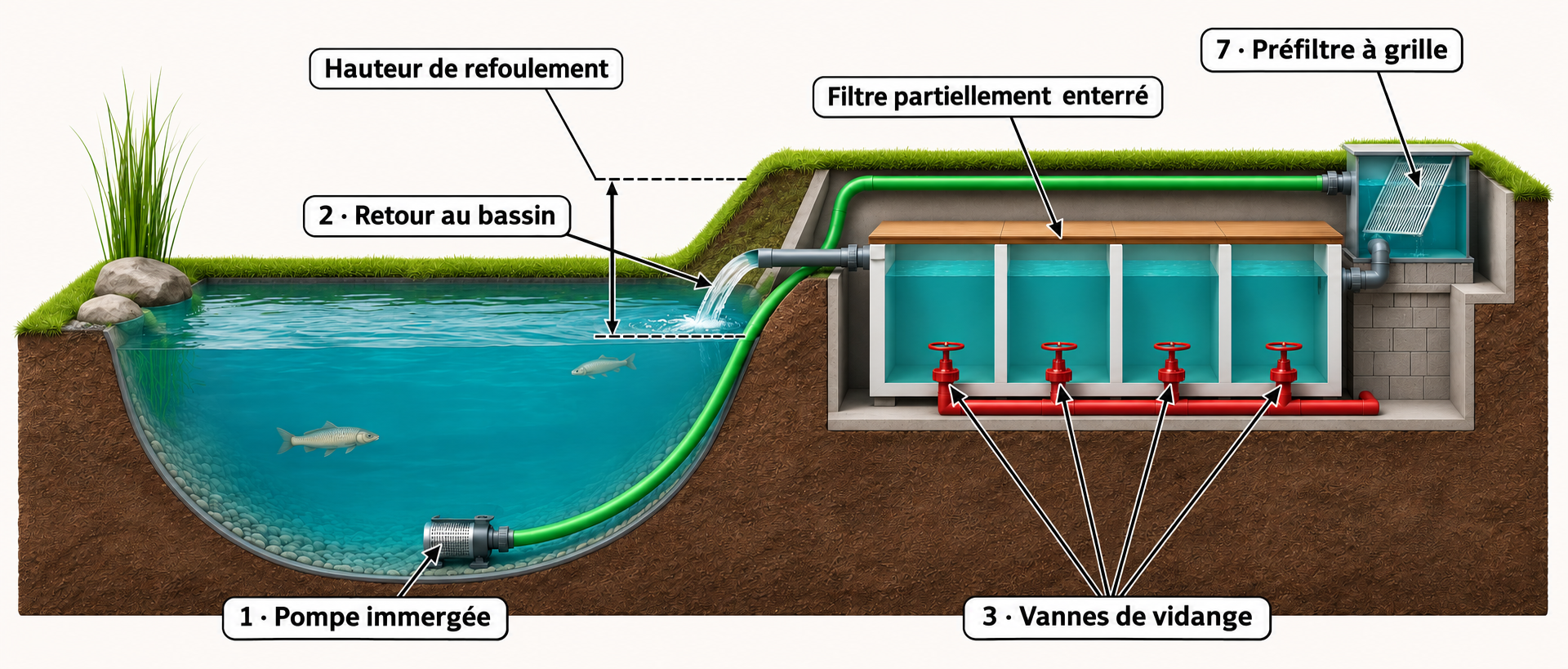
It is the most common method of filtration. It does not require much technical knowledge to be installed. The principle is simple: the pump (*1) is located in the pond, it is raised about 30 centimetres to avoid completely emptying the pond in case of breakage or discharge of a pipe. The pump sends the water to the filter. The filter is installed from the ground level. However, it is possible to bury the filter in part. You will see it further but in both cases a good seat is recommended to support the weight of the filter filled with water.
The filter return to the pond is done by flow from the last chamber of the filter. As the pipe (*2) of the filter outlet is high in relation to the pond level, this is an opportunity to build a small cascade. Do not neglect the diameter of this hose, it must be able to accept all the flow to avoid possible overflow of the filter . The valves (*3), in red on the diagram, represent the "backwash". These valves are usually 50mm in diameter. They are used to evacuate the waste accumulated in the bottom of the filtration chambers, rooms also called "decant areas". These valves can be connected directly to the sewers but you can also recover the water that comes out to water your plantations.
In this example, the filter is of a multi-chamber type. The water enters the first chamber which is usually filled with brushes (mechanical filtration). The following chambers are filled with various filter masses, such as Japanese filter matting, for example (biological filtration). The volume of this biological filtration should be 5% minimum of the volume of the pond but consider that a filter is never large enough and choose a filter too small at first will cost you more than a model well suited to the start. The biological chambers must be oxygenated by a compressor, or air pump, which sends air under the filter masses via bubblers of various sizes. These are made up of balls of different colours, cylindrical diffuser or flat diffuser, etc...
In our example filter, the passage from one chamber to another is done by "upflow" system (*4). It is a system of passage between two chambers that forces the water to come out of one chamber from the top and into the next one from the bottom, under the filtering masses. Know that it is possible to aerate the filter by placing air diffusers in this passage; This is a good solution because you oxygenate the filter without stirring the filter masses.
At the entrance of our filter, a ball valve (*5) will be used to isolate the filter during a cleaning session. When this valve is closed and the pump is turned off, water from the first chamber usually very dirty will not be able to return to the pond, by siphoning effect. After stopping the pump and closing this ball valve, it will be enough to open the back-wash valve to completely empty this chamber to clean it.
In the following diagrams, you will see other technical situations but always based on the "pumped" mode. On the diagram 2, a "skimmer" of bank (*6) is added. It is a very important element in the filtration of a pond because it sucks floating waste before it flows to the bottom of the pond.
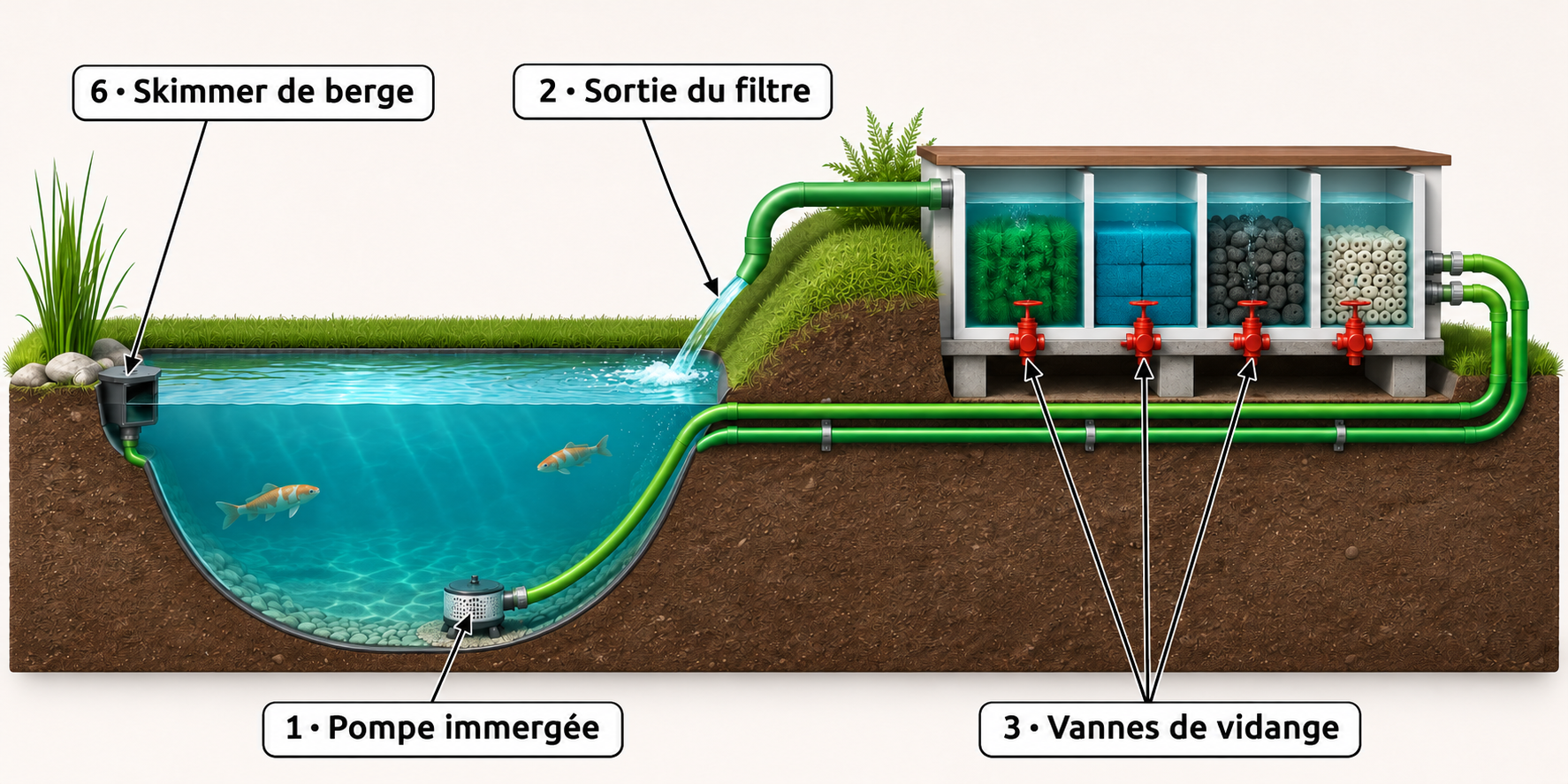
Placing a skimmer in "pumped" mode requires the addition of an additional pump and a second entry to the filter or prefilter. Depending on the skimmer model, the additional pump can be placed inside it, immersed in the pond or outside the pond (dry operation, i.e., out of water but below the water level of the pond). Some skimmer models are provided with an integrated pump but these skimmers are generally for small pools and they are self-contained.
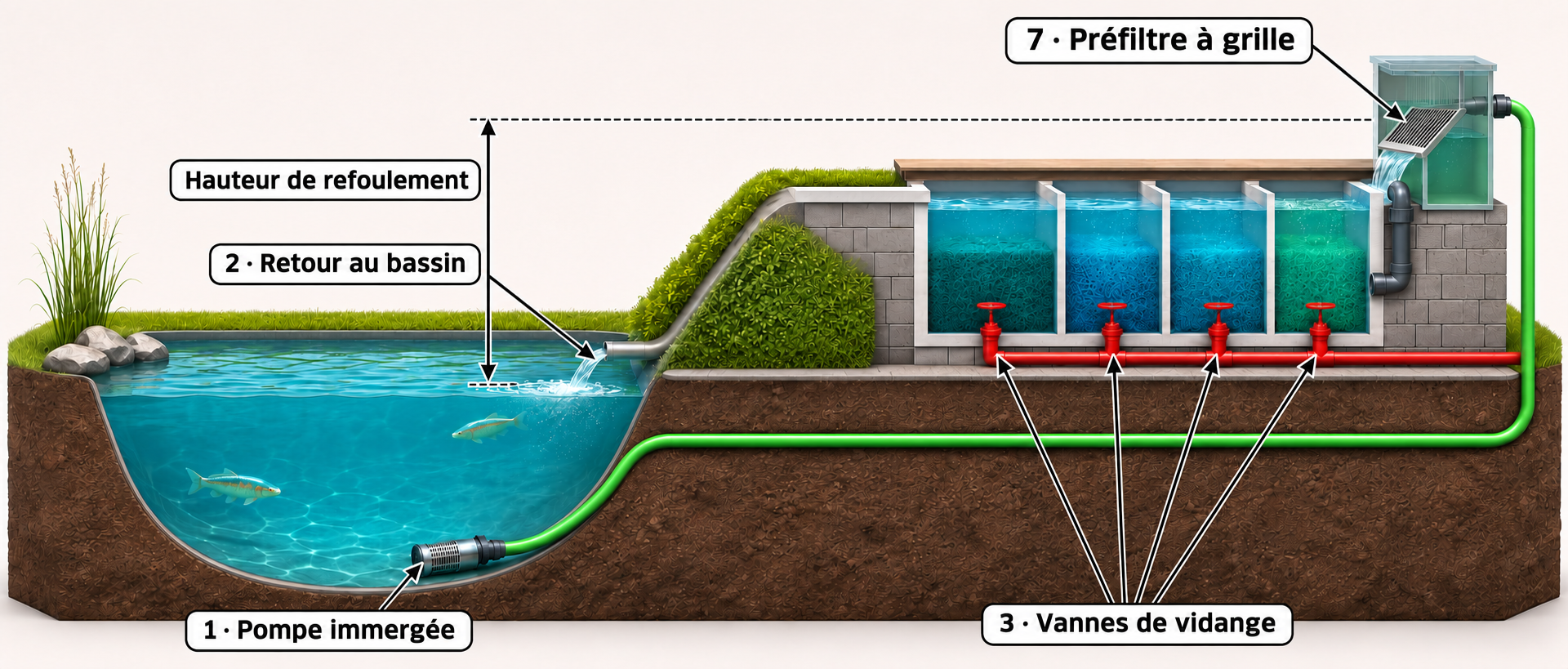
In diagram 3, a grid prefilter (*7) is installed above the filter. Using this type of device facilitates the maintenance of the filter, but unfortunately it causes additional head loss due to the increased discharge height. (See red arrow)
In "pumped" mode, it is also possible to partially bury the filter in order to reduce these load losses (see diagram 4). Your filter will be easier to camouflage at the same time but a technical space will have to be dug to get the filter down. In this case, the filter output will always be higher than the water level of the pond so that the outlet flow can occur naturally. Nevertheless, plan a minimum of 50 cm high between the outlet and the pond so that the flow can be done easily and naturally.
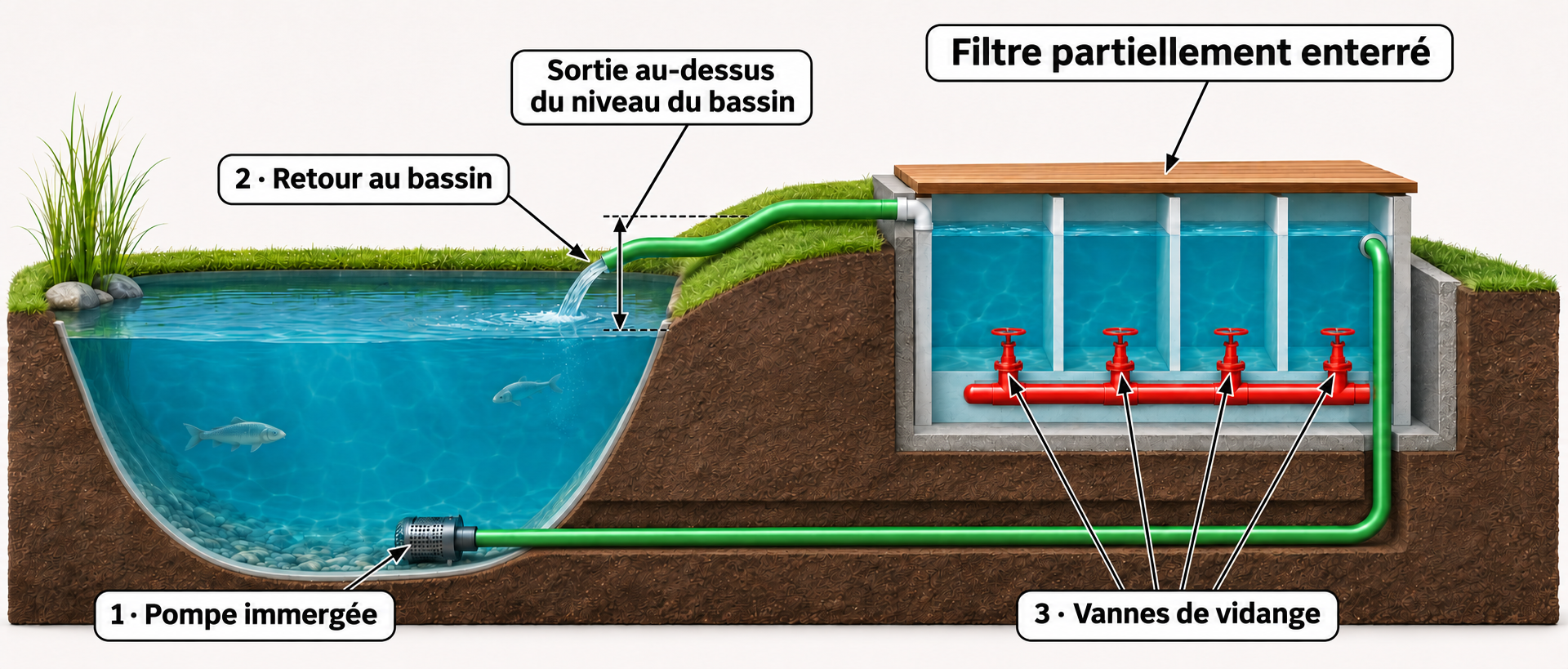
Figure 5 is the same as the previous one but with a grid prefilter. By burying the main filter in part, the height of the load loss will decrease. (See red arrow)
"Gravity" mode
This is the most complex filtration principle because it requires reflection and a little more knowledge for its implementation. It is also the most efficient and economical filtration method, in general. (See diagram 6)
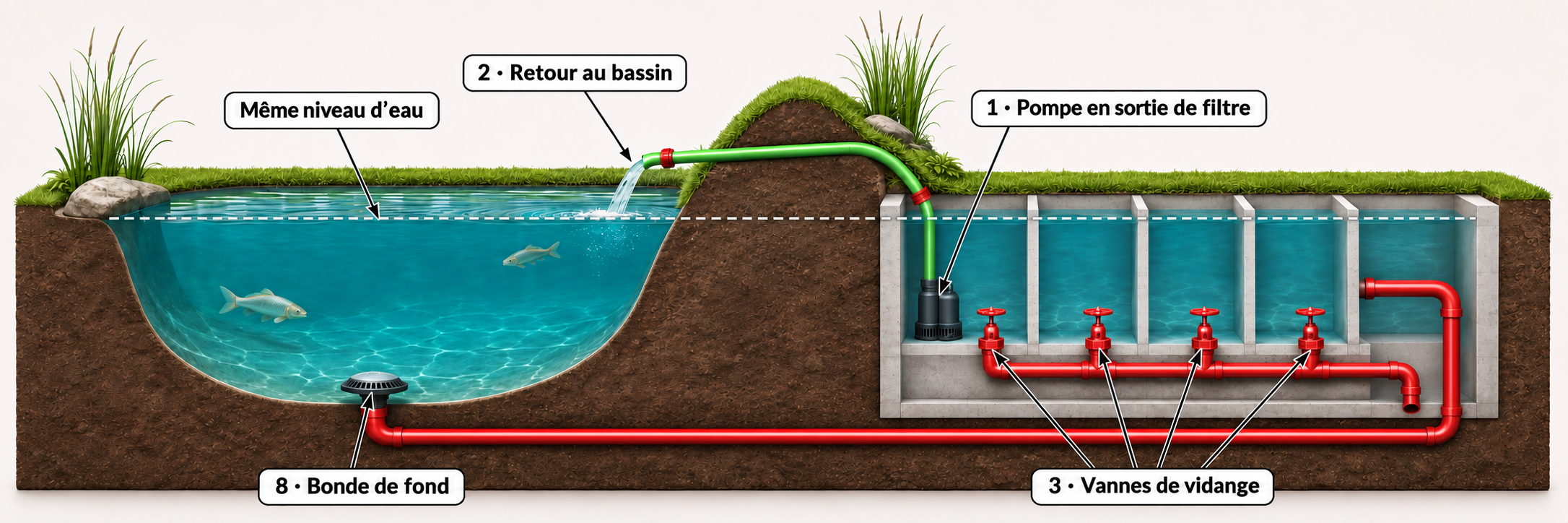
The principle is as follows: one (or more) of the bottom (s) (*8) is placed (s) through the wall at the bottom of the pond. The water is sent to the filter on the principle of communicating vases. It rises in the filter and stabilizes at the same level as the pond.
The pump is installed in various ways: it is immersed in the last chamber of the filter (as in this diagram) or it is placed "dry" (outside the filter but below the water level), depending on the pump model chosen.
The pump sucks water out of the filter and sends it to the pond at the water raz, or under the water, via a waterfall or other decoration knowing that a return via a cascade causes head loss. (See red arrow) It's always good to be able to pass the cascade to isolate from the circuit in winter. This is an element to be expected from the moment of construction.
Accessories ...
Too full.
For all types of ponds, it is recommended to place too full to avoid overflowing the pond and a large water infiltration outside the banks in case of heavy rain. This too full is easy to install and can be connected to draining or a sump, which will allow to recover water for watering the garden. In the case of the sump, do not do it too small if you want to have sufficient water for your waterings.
BENEFITS AND UNCONVENENTS OF THE GRAVITARY MODE
| No pumps in the pool. | Implementation is more difficult in general because everything needs to be planned at the same time as the pond. |
| No visible pipes in the pool. | Only one pump can be sufficient for all filtration. (including skimmer). |
| The pump aspirates water already filtered or prefiltered and the "MS" (suspension materials) are not minced by the pump. | Egouttage is more complex to perform because it is necessary to provide purges for the pipes of the bottom bottom drains. |
| Reduced load losses under certain conditions (without cascade and without grid prefilter). | The filter is more difficult to make yourself. |
| Camouflage of the filter more discreet. | Condensing of bottom bottom drains and pipes, which requires regular purging of these pipes. |
| Less energy-efficient filtration system under certain conditions | Filter mode not suitable for heavily planted ponds. |
| A single pump may be sufficient for all filtration. (including skimmer) | Skimmer is really indispensable. |
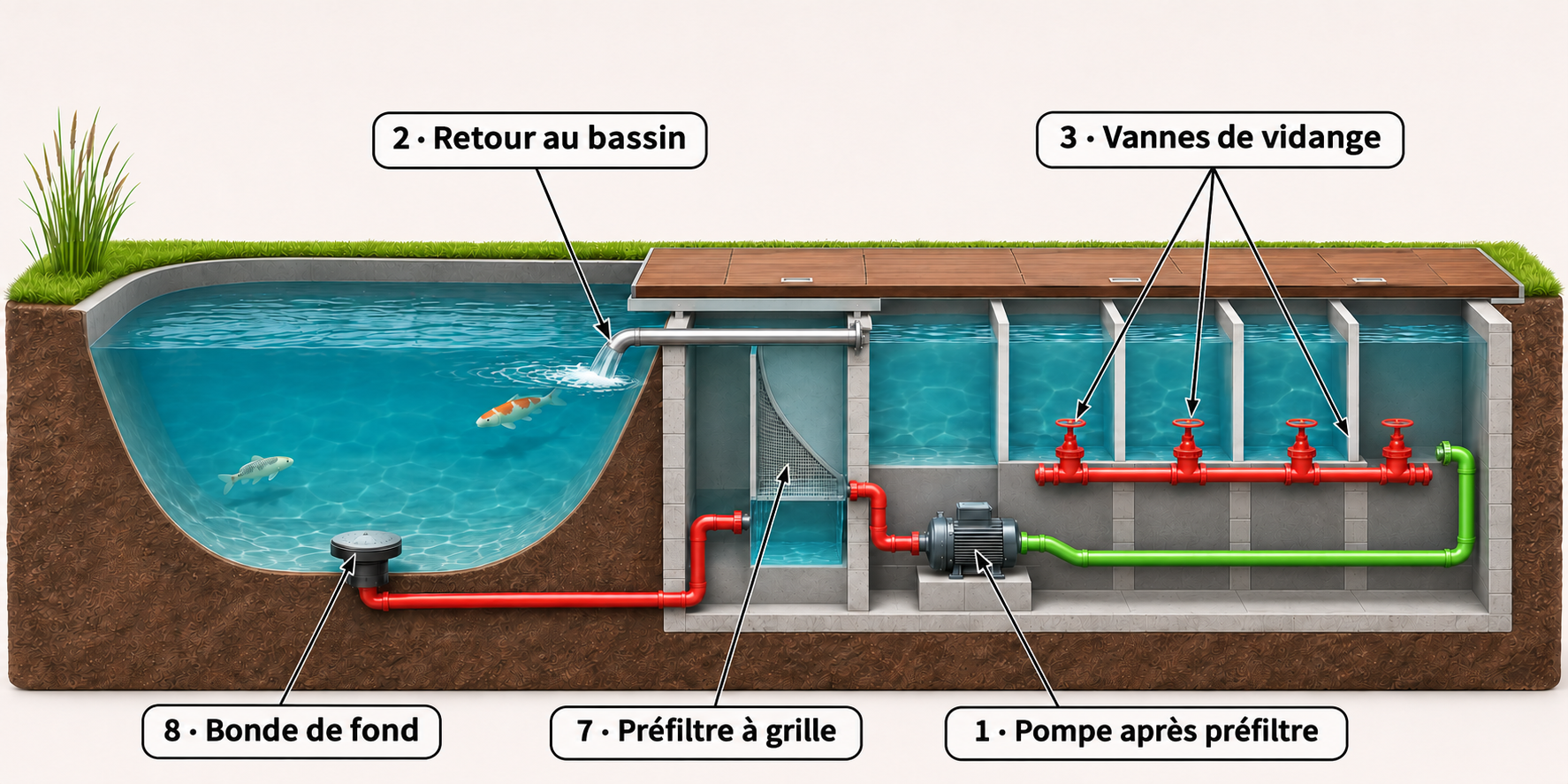
On the last diagram, a grid filter is placed at the beginning of filtration. It is always a "gravitary" type filtration up to the grid prefilter. The water arrives via the bottom cap in the prefilter and stabilizes more or less at the same level as that of the pond in the first part of the prefilters. Then, a float system will regulate the level according to the pump flow. The water passes through a fine mesh grid (250 to 300 μ). The water removed from its largest impurities is then sucked out by the pump at the bottom of the prefilter and is sent to the filter. This is no longer the "gravitary" but the semi-gravitary, so you will also have to count with a small head loss. (See red arrow).
I hope this article will answer some of your questions.