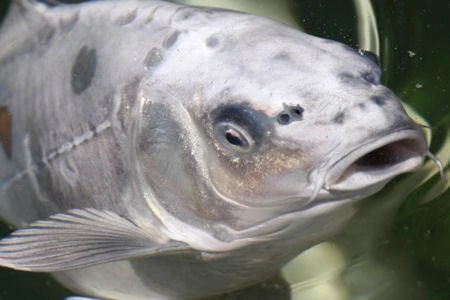
Koi, fish and its needs
The quality of the koi. In the world of Koi, there is a kind of "social status" to classify varieties, "Gosanke" is the word that expresses this status. The term "Gosanke" includes: the Kohaku, the Sanke and the Showa, in other words, these three varieties have the highest status in the Nishikigoi. The varieties are classified in this order: Showa, Sanke, Kohaku, Shiro Utsuri, Goromo etc. It is hard to think that all the Koi come from a black carp originally. A couple of parents can produce up to 300,000 fry, the breeders only have to find among the same fry the unique Koi and then make it grow until it can reproduce and so on. Never another fish was crossed with a Koi to obtain this superb coloration, the crosses only concerned the "Carps". Shiroji (the white color) of the Koi must always be white as snow, the beauty of this color is always the first priority when assessing the fish. This white color we call "bottom" or "bottom color" is very important, it must be put in the mind that white is as important as all others, such as red or black. It is not only an unimportant background color because it will highlight red (Hi). To have a quality Shiroji, the fish must be healthy, if it is sick, the Shiroji can become yellowish, the qualities of water and food must be excellent. For Hi spots to be really red, the fish needs a pigment called "Carotene", this pigment, it cannot produce it itself, so it needs to absorb via its diet. Food manufacturers use "spirulina" to provide the carotene to the fish. Fukurin will further improve the quality of the fish, when the animal is small, its scales are very close to each other and are separated by a thin line. When the fish grows, the space between the scales grows bigger, which leaves a drawing in the shape of a net on the body of the fish is the Fukurin. One of the reasons for the difficulty of raising the Koi is that they have to grow up by promoting their potential as much as possible, it's a challenge to accept if we want to raise this fish.
The most important and difficult is to evaluate the beauty of the Nishikigoi, two Koi are never the same, there is a lot of Koi at 100€, a lot at 1000€, but, even if the prices are the same, beauty is never the same. If at first glance they seem identical, a Koi always has a strong point and a weak point, there are always subtle differences and it takes an informed eye to see them.
There are three criteria for assessing the beauty of a Nishikigoi:
The body silhouette (Body) , quality (Quality) and drawing (Pattern). Quality refers to several criteria, the shape of the body, the drawing, the colors, the scales, the skin and the lineage. The first priority is the body shape, then the quality, and finally, the drawing. If a Koi does not have an interesting body form, even if it is of quality and the drawing is beautiful, he will never win a first prize. The drawings of the Koi are defined by nature and chance, they are absolutely not under the control of the breeders, there are drawings that have a great chance to appear and others, which are much rarer, as for example: an Inazuma pattern of a deep red perfectly centered on the back. To compare two Koi from the point of view of beauty, one can use the method of "separation", it consists of separating the fish into four parts:
The area of the tail, the back, the shoulders and the head. Then we compare the two fish section by section. If you spend several years studying the koi, you will finally understand the beauty of white. At first we study Hi, then Sumi and finally we study Shiroji. When you understand the importance of Shiroji, you can consider yourself as an informed amateur.
The koi and the water is part of the world of Koi, so it is extremely important to keep quality water. Water is strongly linked to the internal fluids of the fish because only a few cells separate the fish from the water, so it has great importance on the internal chemistry of the fish. It is also via water that fish can draw the oxygen necessary for their survival.
Two small reminders:
1. Dissemination is the movement of molecules from an area of high concentration to an area of lower concentration.
2. The osmosis is the passage of water through a membrane such as a gill cell from a diluted solution to a more concentrated solution. Koi have a higher concentration of salts in their bodies than in water, which means that by the phenomenon of d-osmosis, water enters permanently into the fish and, by diffusion, elements leave the fish permanently because salt concentrations will try to balance, these phenomena explain the intimate relationship between water and fish. The Koi is therefore constantly occupied with maintaining these balances between the internal and external concentration via its gills. As nature has done the right thing, the Koi is able to evacuate water via a very diluted urine while controlling its salt concentration via its branches. Koi is a less evolved animal than mammals, it has an adaptability to its environment which is weaker and can quickly succumb to a large imbalance. In nature, there is a complex relationship between the atmosphere and the surface of the water, the work of algae and other cycles that transform matter (carbon cycle, nitrogen cycle). Rivers, oceans, rainfalls, water is very open to its environment. The artificial pond is not part of this great principle of natural water renovation, it only incorporates some natural elements, it is mainly a closed circuit that can rely on its own volume to maintain itself in condition. A pond is still in overpopulation, which makes natural cleansing impossible. Be careful about pH variations, bacteria from filtration do not like a pH under 6.5. Natural light is also very important, it allows the Koi to produce certain vitamins and it also allows the growth of some algae that the fish will eat and that will bring them the essential minerals. This is the reason why farms in Japan are carried out in heated greenhouses, even if a brick building would save energy, the contribution of daylight is irreplaceable and the health of fish depends on it. In Japan, some areas are more conducive to the breeding of certain varieties than others, Mud clay pond may have a different quality from one place to another. Quality Koi farming is not simple, for example, in the small Ojiya City in Niigata, some areas are more conducive to the breeding of certain varieties:
1. The area of Uragata is good for Taisho Sanshoku.
2. The Jyunidaira area is suitable for the Showa Sanshoku.
3. The area of Uonuma is favourable to Asagi.
4. Teradomari's is ideal for Shiro Utsuri.
Quality water produces quality Nishikigoi, white quality (Shiroji) is strongly influenced by the qualities of clay and water in which the fish grows. Water has a huge influence on the Koi, anyone who likes and raises Koi should take this into account.
Koi. Fish and its needs Koi are fish that can adapt to many parts of the world, although Koi are carp, they have been genetically selected by humans and are therefore less resistant than wild carp because genetic diversity is more limited. By simplifying, there are two types of water on earth: seawater and fresh water. The sea accounts for more than 95% of the water on Earth: it is salt water. Accessible fresh water represents less than 1% of the total volume. Distilled water (not adapted to Koi) mixed with a little sea water that brings salt and minerals is a perfect water for the Koi, in other words well balanced water in minerals is what the Koi demand. Niigata water, which comes from the melting of snow, is pure, percolates in the soil and charges itself with minerals, this pure water charged with minerals is that used by farmers. In warm countries such as Singapore or Indonesia, where the water temperature always exceeds 20 °C, the Koi can be fed all year round with the same food. In countries where water temperatures may fall below 10°C during the winter, it is necessary to feed according to temperature as is the case in Japan.
1. Below 10°C, we stop feeding.
2. Between 10 and 15°C food is provided that is easy to digest and contains very little protein.
3. Food for low temperatures is used between 15°C and 20°C.
4. Between 20 and 28°C, food is given that promotes growth and contains a lot of protein. Automated feeding at Omosako.
A Koi does not have a real stomach, in nature he is constantly looking for his food but he cannot consume much of it at one time. So it is necessary to feed them often in small quantities. Noise can cause stress to the fish, on the other hand, the noise caused by the water itself is beneficial, it is desirable to have a waterfall in a pond, researchers have discovered that the noise of the water stimulated the appetite of the Koi. In Japan, very large "Mud pond" (more than two hectares) are used to raise Jumbo (Koi between 70 and 80cm). These "Mud laid" preserve a water of very good quality ideal for fish, they are away from noise, human activities and in a quiet place where they can grow without stress from the environment. These small pockets of nature slowly polish these living jewels.
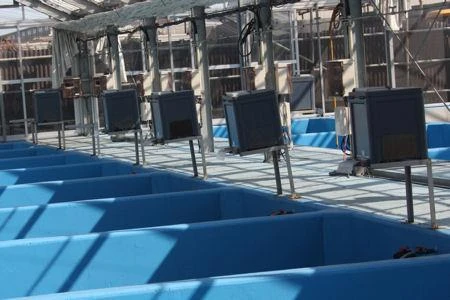
The anatomy. I will not teach you anything by writing that the Koi lives in the water and that it is a very different environment from the air. The shape of the body is important, often fish have a larger size at the front than at the back because this hydrodynamic form minimizes turbulence in the water, and facilitates progression. Underwater breathing also requires a lot of effort because of the density of the liquid compared to that of the air, it is estimated that 10% of the oxygen extracted from the water is used for breathing. When you take a fish in hand, it is viscous because it is covered with "mucus", it is secreted by the skin and it has two main functions: lubrication because the mucus facilitates movement in water but also protection against microbes, viruses, bacteria and other fungi. The mucus has antiseptic properties and contains natural antibodies, as it is permanently replaced, the pathogens are evacuated with it. The mucus gives a viscous appearance to the fish, but it is an indispensable protection.
The skin of a fish consists of two parts, the outer layer or epidermis which is very thin and covers the scales, the epidermis secretes the mucus and isolates the fish from the surrounding environment, it constantly renews. The second layer, the dermis, contains blood vessels, nerves and certain sensory organs and chromatophores or pigmented cells that give its color to the fish. The scales are produced by the dermis, if one comes to fall, it is replaced, the scales of the Koi are formed by a fibrous layer covered with calcium phosphate and calcium carbonate. The scales protect the fish.
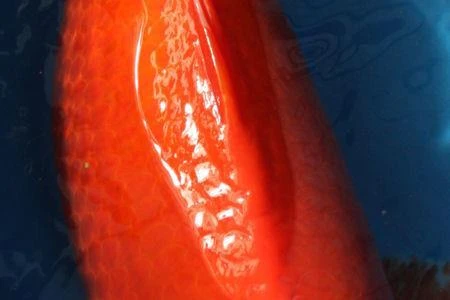
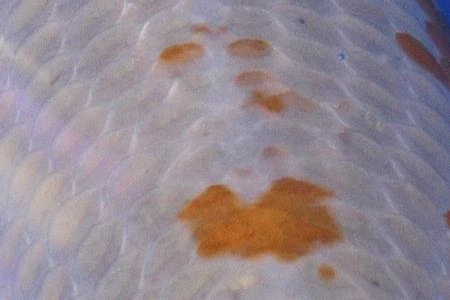
The sensory system of fish is called "sideline", in fact on each side, there is a row of scales pierced from a small hole connected to a canal. In these channels, there are sensory cells sensitive to water vibrations that transmit information to the brains of fish. The Koi are provided with a complex skeleton made up of much more than in mammals, the skeletal function is always double: it protects fragile organs such as the brain, heart, digestive system etc. It also serves as an anchoring point for muscles. The digestive system begins with the mouth which is without teeth, then it is the pharynx which it, is equipped with bone plaques called "pharyngian teeth" that are used to crush food. Koi does not have a stomach as such, the food arrives directly in the intestinal canal where it is absorbed by the circulatory system and transported to the liver, this one is very important in fish, it serves primarily to store glycogen (This is the form in which carbohydrates are stored in the organism). In case of energy need, the glycogen is transformed into glucose as needed. The liver also filters the waste and secretes the "bile" which is then directed towards the intestine to be evacuated. The lateral line of this fish is perfectly visible.
The process of regulating water is a fundamental phenomenon in fish physiology, and it should be noted that the less concentrated water flows to more concentrated water through a semi-permeable membrane. In this case, the body fluids of fish contain more salts than the ambient environment. The water will tend to penetrate the fish to balance the concentrations, the salts going the opposite way (a fish does not need to drink). The gills and skin of the fish are semi-permeable membranes, so they will permanently absorb water. To keep its internal salt concentration constant, the fish must constantly absorb salts via specialized gill cells and evacuate water through the kidneys, the urine of the fish is heavily diluted. In the event of problems of osmoregulation, fish can inflate, which is called hydropisia. gills are the main breathing organs of fish, they represent a very large exchange surface and allow blood cells to absorb oxygen and remove waste. Almost 90% of the waste is disposed of via gills in the form of ammonia and urea, the rest is evacuated by the kidneys. The swim bladder allows to control the buoyancy of the fish and allows it to move in a water column. The buoyancy is rectified by controlling the volume of gas in the natatory bladder, the Koi absorbs air to control this volume, it has a bladder Physostom. Other fish control the volume of gas internally (Physoclist bladder, this bladder has no connection to the esophagus), the bladder has a second function which is the amplification of external sounds.