The Sanke
Family of Taisho Sanshoku
Origins:
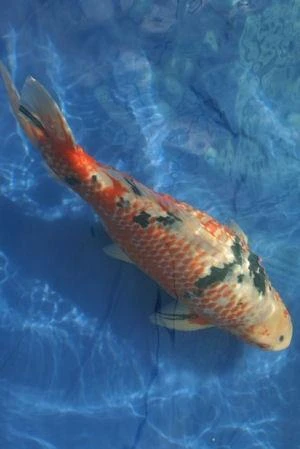
The exact origin of the Sanke is not certain, in his book, Mr. Kuroki quotes Mr. Eziburo Hoshino as the first breeder while Peter Waddington speaks to him, of Mr. Kawakami (Torazo), who would have been the first to raise Sanke around 1915. The Sanke family was stabilized during the reign of Emperor Yoshihito, that is, the "Taisho" era (between 1912 and 1926) hence its name. Taisho means "great virtue, uprightness" Sanshoku means "three colors" the full name is "Taisho Sanshoku", often abbreviated in "Taisho Sanke" and finally reduced to "Sanke". It comes from one of the two main lines derived from Magoi, the lineage Asagi Magoi (of the other lineage Tetsu Magoi comes from Showa). Due to their different origins, the Showa and the Sanke developed a different Sumi (black) the Tetsu Magoi (of which the Showa is native) had a rather weak and matte Sumi that started from the bottom of the lateral line and went up to the dorsal fin wrapping the body of the fish. The Asagi Magoi, of which the Sanke is native, produced a Sumi of a glossy blue-black that appears above the lateral line. The Taisho Sanshoku was developed from Kohaku around 1914, it is part of what is called the Gosanke. It is a Kohaku... No, it has a Sumi brand, so it is a Sanke.
One day, in Kohaku farms, a fish appeared with small stains of a dirty black spread over the body. It must be remembered that the original carp of the Nishikigoi is the black carp called Magoi, some breeders worked by raising and selecting fry to collect the disparate Sumi tasks and make them more important tasks that could balance Hi tasks. The first Sanke was brought to the Tokyo exhibition in 1914. For years, Gosanke were crossed between them by breeders such as Toshio Sakai and Minoru Mano (Dainishi) in order to improve them. One of the results of these crosses was a decrease in the size and thickness of Sumi in the Sanke, which may have led some breeders like Toshio Sakai to look for another type of Sumi for the Sanke called Atarashi Sumi (see "The Evolution").
How can you recognize a Sanké with certainty?
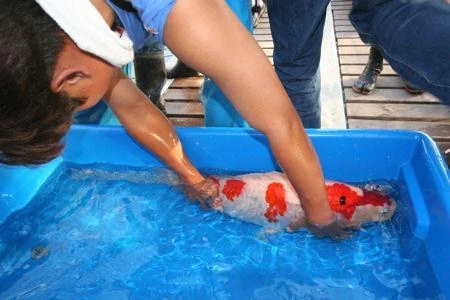
If you read the page about the Showa you will notice that these two families can look alike. Unlike the Showa, the background color of the Sanke is Shiroji (white), which gives a fish of a less dark appearance. With a little habit, it becomes impossible to confuse them, so check the following three points.
Item 1:
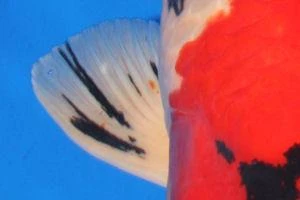
The pectoral fins of the Sanke can be white or then have some black lines called Teijima. Attention, some Showa may also have Teijima's.
Item 2:
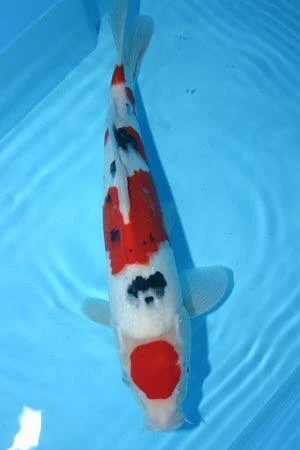
The head of the Sanke must be devoid of black spots (sumi), it must resemble that of a Kohaku, the Sumi marks should, as in the picture, begin at the shoulders of the fish.
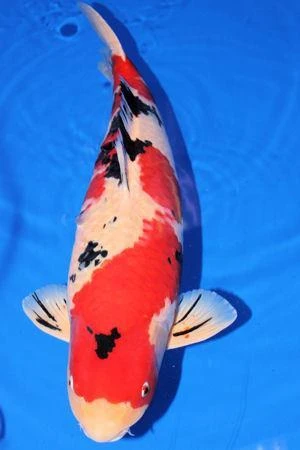
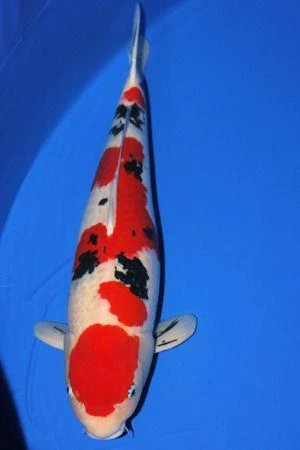
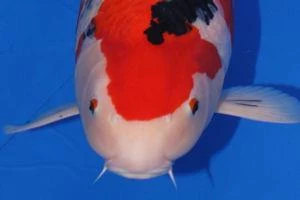
Item 3:
The black marks of the Sanke are relatively small compared to those of the Showa. Since the basic color of the fish is white, there should be no tasks under the lateral line.
Developments:
In 1919, fry belonging to a farmer named Heitaro Sato showed for the first time red and black spots but it was not possible to reproduce this. Another breeder crossed a female from Heitaro with a Shiro Bekko and the offspring had the three colors, white, red and black. The breeder who stabilized the variety is Mr Torakichi Kawikame, this one is at the origin of the lineage "Torazo" of his father's name, all modern Sanke are from this lineage. The current lines are Matsunosuke, Jinbei, Sadazo and Kichinai. Mr Toshio Sakai is known for his Matsunosoke Sanke. As written in "The Origins", the different crosses have led to a decrease in the size and depth of the Sumi brands, the Atarashi Sumi is the latest evolution of Mr. Toshio Sakai's Matsunosuke lineage. The goal is to give the Sanke more important Sumi spots as originally without losing the qualities of Shiroji, Hi and of course, the brilliance of the typical Sumi Sanke. Another objective was to get the Kiwa Maruzome. The origins of this new Sumi for the Sanke remain a well-kept secret, but one can think without too much protruding that there was somewhere from the Showa because some typical features are present such as the Menware, Motoguro and Sumi enveloping the body of the fish. With this variety of Sanke, the discussions "it's a Showa" or "it is a Sanke" still have nice days ahead of them. As this trend is still very young, we can expect it to improve and lose the features "Showa".
How to judge the quality of a Sanke?
1. Shiroji (white) must be very pure.
2. The Sumi (black) marks must be deep and well distributed, mainly in the
Shiroji.
3. The head must be without Sumi marks but this is not an absolute obligation.
4. The fins may have Teijima.
Selecting a Sanke looks very much like selecting a Kohaku, a Sanke is mainly a good Kohaku with some black spots regularly placed. Take a Sanke, remove the Sumi marks and you have a Kohaku , take the same Sanke , remove the Hi and you get a Shiro Bekko . The balance of the designs and the quality of the skin are important elements when selecting a young Sanke . The head of a Sanke is as for all very important koi varieties, it should have the same characteristics as the head of a Kohaku i.e., a Hi brand that does not exceed the nostrils of the
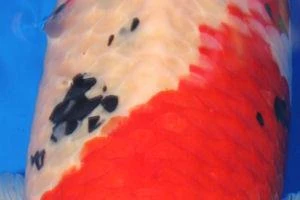
fish. Ideally, the first Sumi marks should be on the shoulders and not on the head, this will give an impression of power to the fish when it grows. If the Sumi marks are located mainly at the back of the fish, it gives an effect of elongation of the fish that is not very pleasant. It is also preferable to have the Sumi brands located in Shiroji and not in the Hi, the modern Sanke are usually Kohaku with six small Sumi brands situated in the Shiroji. It is better that Sumi brands are mostly present in Shiroj and not in Hi.
A Sanke should have 70% Hi, 10% Sumi and the rest is 20% Shiroji. When choosing a young Sanke, give priority to the Hi sufficient and well distributed over the body with very little Sumi because it tends to appear with the age of the fish. Avoid a Sanke with many small Sumi points on the body, each Sumi brand must be well separated from the others and have a surface of several scales.
The Hi of the Sanke, like the Kohaku, can be orange red because it often improves with the age of the fish. The fins can all be white or have thin black lines (Teijima), but there can be no Hi (Motoaka) marks. Be careful when selecting because if there is too much Sumi on the fins, once grown up, these can become too dark. As with all koi, look for a fish with large shoulders and large pectorals, it indicates a great potential for growth.
Varieties and Sub Varieties
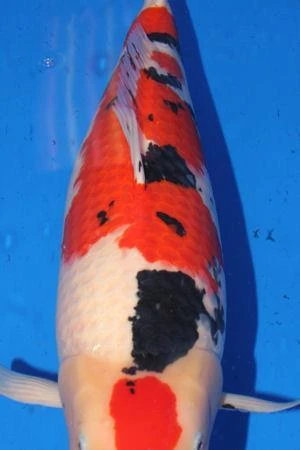
The Sanke Atarashi Sumi The Doitsu Sanke The Sumi of this Sanke resembles the Sumi of a Showa.
Variety without scales of the Sanke.
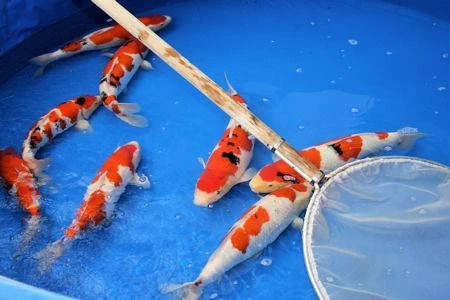
Sanke Ginrin The Aka Sanke Sanke variety with Ginrin scales. In this variety, Hi is predominant.
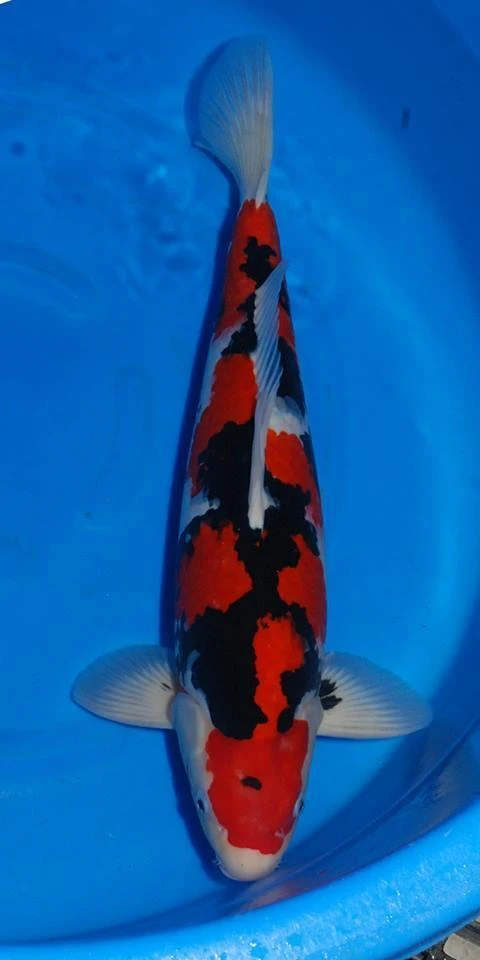
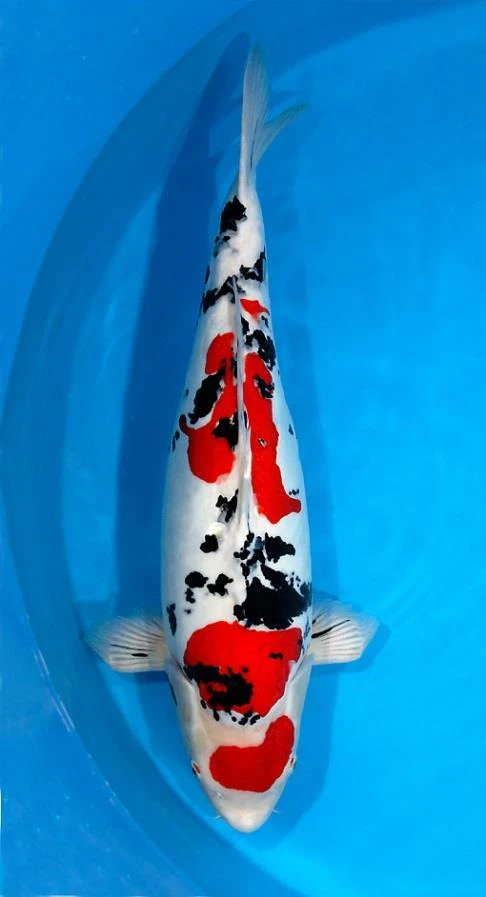
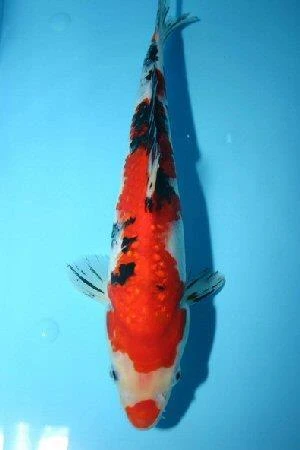
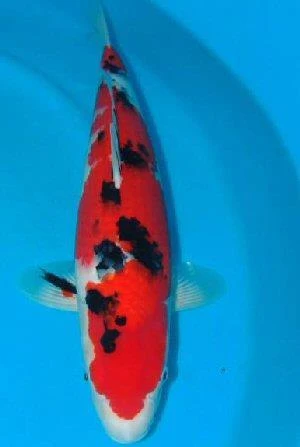
The Maruten Sanke The Kanoko Sanke This variety has the peculiarity of having a red spot on the head.
The Hi brands of this variety are the size of a scale.
Glossary:
Asagi Magoi:
One of the first descendants of the Magoi carp, this line is at the base of the Goshiki, Kohaku, Goromo and Sanke.
Atarashi Sumi:
New Sumi for the Sanke, larger and deeper that comes close to the Sumi of the Showa, it was developed by Toshio Sakai.
Teijima:
Sumi in band form, a term often used to describe the pectoral fins of a Sanke.
Maruzome Kiwa:
The Kiwa follows the shape of the scales, also known as Tama Giwa, is one of the two main primary forms of Kiwa, it is mainly present in the line Dainichi, this form of Kiwa is sought.
Menware:
Describes a Sumi stain that divides the head, it's also called Menware. A good Hachiware goes from head to shoulders with an Inazuma shape. It's present on Shiro Utsuri, Showa Kin Showa and other Utsuris.
Motoguro:
Sumi spots at the base of the pectorals, ideally they must represent 30% of the surface. This should appear on varieties from Karasugoi such as Showa, Shiro Utsuri, Kunomryu, Beni Kumonryu etc.