
The Showa Sanshoku
Family of Showa Sanshoku
Origins:
The Showa is one of the great Koi families known as the Gosanke. It is historically the most recent of the three that are to recall Kohaku, Sanke and Showa. Its full name is the Showa Sanshoku, this variety was stabilized around 1927 by Jukichi Hoshino during the reign of Emperor Hiro Hito, that is, during the Showa era (1926 - 1989). It comes from one of the two descendant lines of the Magoi, the Tetsu Magoi lineage as well as another very close family, the Shiro Utsuri. Showa means "clearness, instruction, harmony". In 1927, Jukichi Hoshino used a Ki Utsuri as one of the parents and this very first Showa was of very low quality, it was not until Tomiji Kobayashi came across Showa with Kohaku in the 1960s that we were able to obtain the quality that we currently know.
Because of their different origins, the Showa and the Sanke developed a different Sumi (black). The Tetsu Magoi (of which the Showa is native) had a rather weak and matte Sumi which started from below the lateral line and went up to the dorsal fin by wrapping the body of the fish. The Asagi Magoï (of which Sanke is native) produced a Sumi of a glossy blue black that appears above the lateral line. It can be noted during the Koi show, when the fish are placed in blue bins, that the lines of separation of the Sumi des Showa and Shiro Utsuri are also a little more blurred than those of the Sanke. This is also due to the lineage Tetu Magoï which was a less refined fish and closer to the wild carp for which the color was only camouflage. This camouflage had to be able to change because going unnoticed was the key to survival. For years, Gosanke were crossed between them by breeders like Toshio Sakai and Minoru Mano (Dainishi) in order to improve hi (red) and Shiroji (white) Showa.
How can you recognize a Showa for sure?
The Showa can be confused with the Sanke because the colors are the same as red (Hi), white (Shiroji) and black (Sumi), but one of the differences between the two families is the basic color of the Showa which is black and it has red and white marks while the Sanke has a white base color and red and black spots.
To differentiate them, the following three points must be checked:
Item 1:
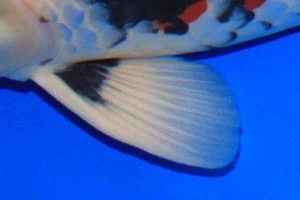
The Showa has Motoguro, i.e. Sumi at the base of the pectoral fins. It also has Sumi on the other fins while the Sanke has Teijima on the pectorales but this is not an obligation, there are Showa with Teijima even very light. To have perfect pectorals, the Sumi must represent 30% of the surface of the fin.
Item 2:
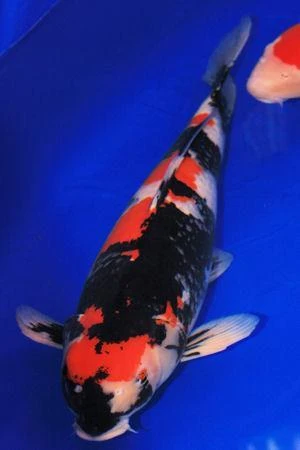
The Showa has Sumi on its head while the Sanke does not. The mark on its head is called Hatchiware or Menware.
Item 3:
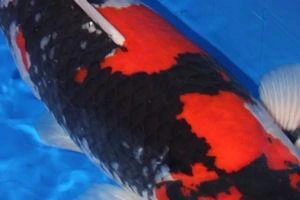
The Sumi drawing is different on the Showa, it is in the form of large spots that can pass under the lateral line because it is the basic color of the fish while it is smaller on the Sanke and limited over the lateral line.
Developments:
Prior to 1975, the Showa were represented by the Kobayashi lineage, these Showa had a lot of Sumi and very few Shiroji, Sumi and Hi were often covered, and due to the large amount of Sumi, this fish gave a great impression of power. Some breeders were not satisfied with this lineage because they thought that the Sumi very present gave an impression of power but also somewhere a lack of beauty. This is the reason why they have developed a "new Showa" called Kindai Showa. Showa's fry are born black, color spots appear with growth, in a laying of Showa parents, only between 10 and 30% will become Showa.

How to judge the quality of a Showa?
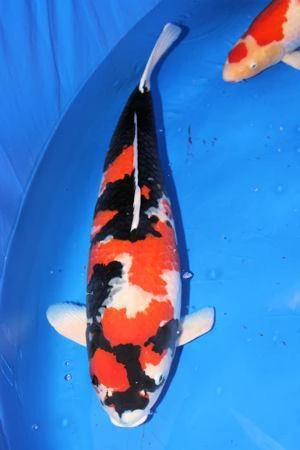
1. A Showa judge itself at the base as a Kohaku, the layout of Hi brands is very important.
2. Sumi marks must be well balanced and well distributed.
3. The area just before the tail (Odomus) must be white.
4. Ideally, the three colours must be present on the head.
5. The dorsal fin should be white to contrast well with Sumi.
6. The Motoguro must cover 30% of pectoral fins.
The Hi of a Showa is not like the Hi of a Sanke, Showa's fry are completely black, when the red starts to appear, it is greenish and will become a mustard color then finally a dark orange. After years, this color can become scarlet. Sumi d'un Showa tends to appear randomly on the body, it also tends to appear as a group instead of being properly distributed over the whole body. The Sumi must start from below the lateral line and go up towards the back a little like mountain peaks. Sumi marks begin to appear on these young Showa.
Sumi's colour is less bright than that of Sanke. Sumi tends to be matte, which is why breeding programs have brought blood from Sanke, which has greatly increased the quality of Sumi Showa. Sanke's blood supply has created a few fish that are difficult to identify: Showa or Sanke because the characters of both families are mixed. Purists say that these fish whose family is unknown should be eliminated but there are fans for the Koi of this type and in the end, the breeders are also businessmen. At the Koi Show, even judges sometimes have the greatest difficulty in determining the family, it is not uncommon to see them looking in the mouth of the fish in search of Sumi's trace, if they find it, it is a Showa, if they do not find it, is not sure that it is a Sanke. This tendency to group the Sumi can sometimes unbalance the fish, so it is rare that the Sumi is evenly distributed from head to tail and in good harmony with the Shiroji. Pectoral fins may have a black spot at their base called Motoguro. An interesting point also is the "surprise" side of the Showa, it is difficult to predict the evolution that the Koi will have in the coming years. It's kind of the Koi of the players.
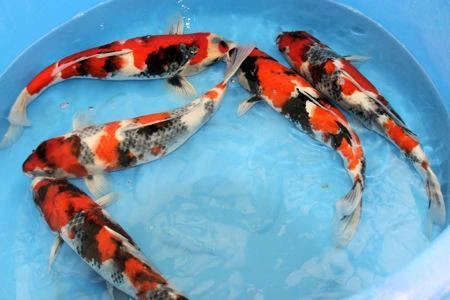
Narita is one of the largest dealers in Japan.
A Koi that may seem uninteresting can reveal very good surprises. The Shiroji of a Showa must be white as snow. Although originally there was not much Shiroji, the modern Showa currently produced have many more. If a Showa has less than 20% white, it is a traditional Showa and not a Kindai Showa. Selecting a good young Showa is certainly one of the most difficult choices to make. The Showa changes strongly during its growth, it can also take a lot of time to grow, in fact it sometimes takes five years for the development of the fish to be complete. Often, the Sumi of a young Showa has been deeply fled under the skin and may appear as greyish spots, this does not indicate a poor quality of Shiroji but Sumi brands that will appear later in the development of fish. Start the selection of a young Showa as for the other Koi while looking at the head, it should have the three colors: Hi, Sumi and Shiroji (preferably in equal quantities). The ideal is to have a beautiful Kohaku head with a Sumi brand in the shape of lightning or "Y". After, choose a fish with a nice drawing style Kohaku well balanced over the whole body, then look if the Sumi is present or if it will appear all over the body. The Sumi tends to appear from the back of the fish as it goes forward, so it is normal to have Sumi marks already well present at the back and in formation at the front of the fish. Also make sure that the Sumi marks start from below the lateral line, these Sumi marks starting from the belly tend to develop and climb enveloping the body towards the back, they also seem to be more stable. Another important point is the pectoral fins, ideally, the inner third (near the body) should be black. Growing up, the black part of the pectorales will keep the same surface, it is the white part outside the fin that will grow, which is why a young Showa with completely black pectorals can also be promising because as it grows, white will appear outside.
The pectorals still black of this young Showa will lighten up when the fish grows. Sumi will also assert itself with age.
If the Showa is already three years old and the pectoral white has not begun to appear, this can be a problem for the future evolution of the fish. In any case, Hi marks cannot be found on the fins.
Varieties and Sub Varieties
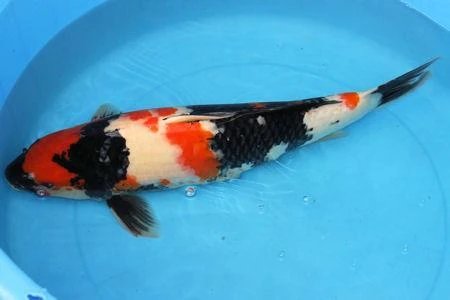
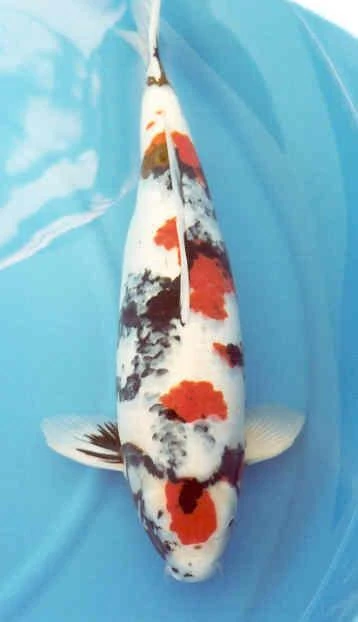
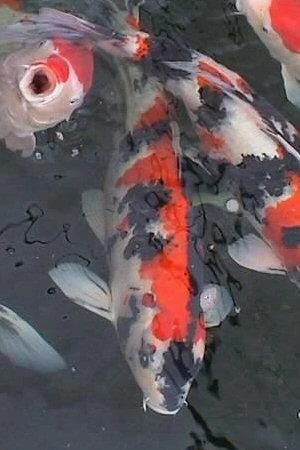
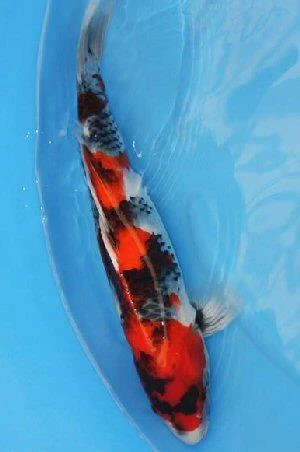
The Doitsu Showa The Ginrin Showa The DoitSu Showa is a Showa without scales or only a line of scales on either side of the back and along the lateral line. The Ginrine Showa has very bright scales, which gives it a very strong reflection.
Classic Showa: Kobayashi Kindai Showa lineage Original lineage with a lot of Sumi. Showa of a more modern lineage, with much more balanced colors, it has a minimum 20% white. It is characterized by the separation of Hi and Sumi. The Hi and the Sumi are therefore much more harmonious.
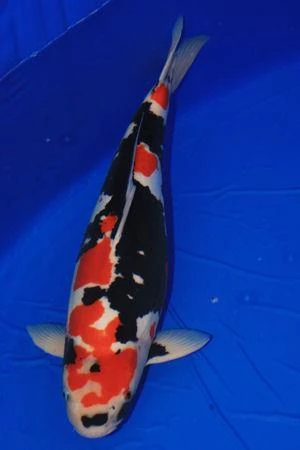
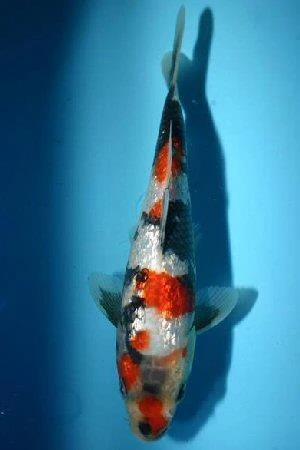
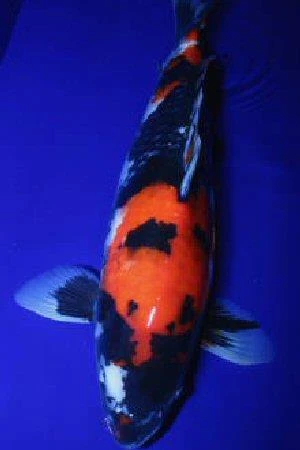
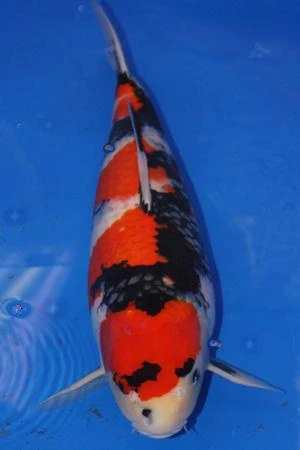
Hi Showa Boke Showa In the livery of this variety, the Hi dominates. Sumi and Shiroji are equal. If, seen from above, the Hi exceeds 50% of the visible surface of the body, it is called Hi Showa. Showa whose Hi is in the form of small spots.
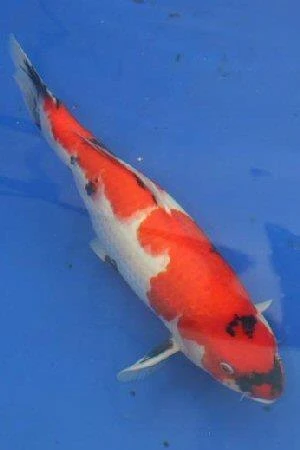
Showa Teijima Kage Showa For this Showa, we can notice that the pectorals do not have Motoguro brands but bands called Teijima as for the Sanke. The Kage ShowA has an almost grey blurred Sumi which will appear rather in blue tones.
Glossary:
Teijima:
Sumi in band form, this term is often used to describe the pectoral fins of a Sanke.
Motoguro:
These are Sumi spots at the base of the pectorals. Ideally, they must represent 30% of the surface. This should appear on varieties from Karasugoi such as Showa, Shiro Utsuri, Kumonryu, Beni Kumonryus etc.
Gosanke:
There are more than 80 varieties of Nishikigoi. In these 80 varieties, Kohaku, Taisho Sanshoku and Showa Sanshoku are considered particularly important and these three species are grouped under the name Gosanke.
Hachiware:
Tache Sumi, which divides the head, is also called Menware. A good Hachiware goes from head to shoulders with an Inazuma shape. It's present on Shiro Utsuri, Showa the Kin Showa and other Utsuris.