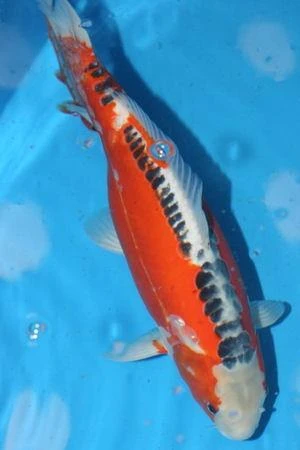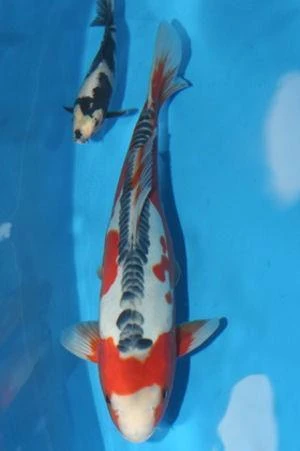
The Shusui
Shusui family
Origins:
The origin of Shusui is the result of the crossing of a European carp Doitsu and the Asagi of Japan. Around 1910, Mr Kichigoro Akiyama crossed a Doitsu of Germany with an Asagi to create Shusui. In Japanese, Shusui means "Fall Water". Subsequently, this Shusui was crossed with many other varieties to make varieties such as Doitsu Kohaku, Doitsu Showa, DoitSu Ogon etc. At the start of some Doitsu black carp imported from Europe a hundred years ago, this magnificent Shusui has been developed along with other beautiful current Doitsu varieties. For example, a breeder crossed a Shusui with a Platinum and that gave the Ginsui. Ki Shusui, on the other hand, is very rare. For this variety, yellow (Ki) replaces red (Hi). Various other varieties are the result of crosses between a Shusui and another scaly variety, for example: Showa Shusui, Sanke Shusui or Goshiki Shusui.
How can you recognize a Shusui with certainty?
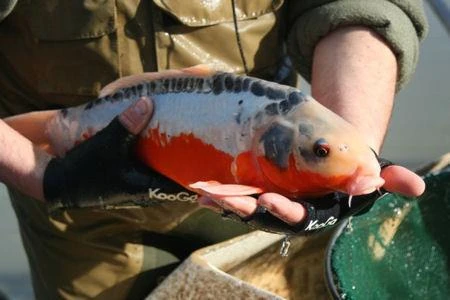
A classic Shusui has a white head, an orange red belly and hearing and a bluish back with a row of large scales on both sides of the back.
Item 1:
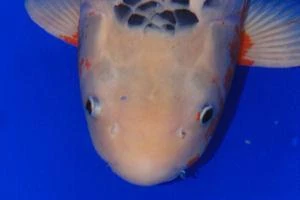
A Shusui, just like the Asagi must have a perfectly white head.
Item 2:
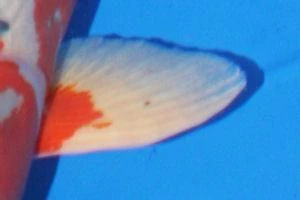
Like the Asagi, the Shusui can have Motoaka on the pectorals.
Item 3:
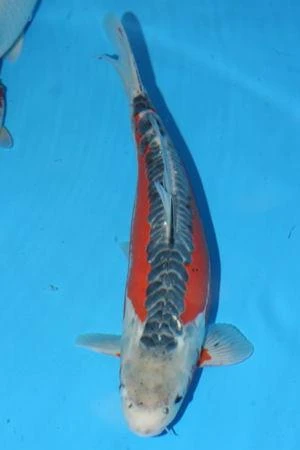
On both sides of the back there is a row of large scales that are Ai (Indido) coloured. These are the same scales as on the back of the Asagi.
Developments:
The Shusui Hi is almost stable, it's not like the Sumi of the Kumonryu that it, evolves in the season. It will just vary slightly between its Tosai period and the age of two years, in the end all depends also on the lineage of the fish and some Shusui continue to evolve until they become mature. The skin of a Shusui is at the beginning of a beautiful blue but as it grows, the blue will weaken to tend towards white while the Hi will deepen.
How to judge or select a Shusui?
1. The head must be perfectly white.
2. The Motoaka shall not exceed 30% of the pectoral.
3. The scales on the back are very important for Shusui, a perfect alignment and shape are mandatory.
4. Blue and orange must be well marked.
Shusui will be selected with almost the same criteria as Asagi because it is an Asagi Doitsu. As Shusui is a Doitsu, you should not look for the cross-linked aspect of scales but rather their regularity on either side of the back, they must have the same blue Indigo colour as the Asagi. What is absolutely necessary to avoid at the level of the scales of the back is an additional badly placed scale called Mudagoke in Japanese. The Shusui will see his drawing Hi increase with age, so if you choose a tosai that already has a lot of Hi, it risks growing to be much too red. In fact, a Shusui is really Shusui only around the age of three when the blue is well marked, it's only then that you really see what you have as a fish.
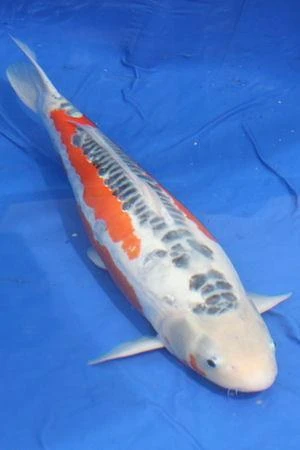
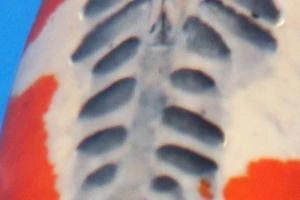
A young Shusui.
One important thing to look at is the nose which must be white. The head, it can be grey because you can see the skull by transparency but it will whiten when the fish grows because the skin will thicken. When you talk about the nose, it represents the region that starts from the mouth and goes up to the eyes. Next point, look for red that surrounds the ears a little in the shape of a horse iron, if there is none, look for Red on the lower third of these same ears. A Shusui of the "Etangs d'Occitanie". Thanks to Freddo de Valencia for the photo.
Another thing to look at is the red on the belly. The Japanese compare this red which is rather an orange red with the paint covering the keel of the boats, if the red does not climb the sides, turn the fish back to examine it well. The ideal would be to find a fish with white in the bottom of the belly then red on the sides but that does not rise higher than the lateral line, although the modern Shusui can have Hi higher than the side line for as long as it is in balance on both sides of the fish. As Shusui is Doitsu, it will tend to have small black spots called Jyami. Pectorals are also important, the ideal would be pectorals that would have red on 1/3 of their surface, otherwise, look for pectoral ones that show a little white at the extremities. Normally, with age, red will decrease to the desired 1/3 but it is not a certainty. The same thing for the caudal fin, there should be red at its base on a surface between 1/3 and half. The dorsal fin should have a thin red line just at its base, at the junction with the body, not higher. Avoid fish that have red in the dorsal, this could indicate that by growing the fish will become too red.
Varieties and Sub Varieties
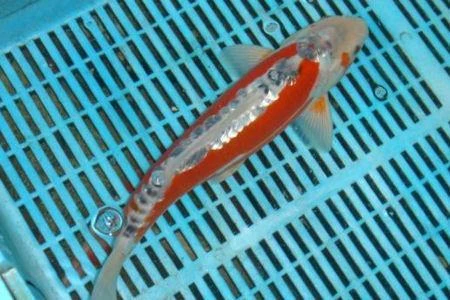
The Hi Shusui The Hanna Shusui Hi Shusuy has the Hi which covers entirely the blue background.
Hanna Shusui has the Hi which is in the form of stains in Shiroji.
Glossary:
Motoaka:
Hi tache at the base of the pectorals, this is a negative point for a Kohaku. However, it is a characteristic of the Asagi and Shusui.
Mudagoke:
Irregular scale or wrongly placed on a Koi Doitsu. The two scales that leave the shoulders to reach the tail are very important in the beauty of a Shusui. Any scale that leaves this alignment is very damaging.
Jyamy:
A pack of Sumi small dots, also called Jyari Zumi or Goma Jyami. These spots can appear on the Hi as on the Shiroji.