
The Asagi
Family of the Asagi
Origins:
For the Japanese, there are three types of Magoi, and among these three there are the Asagi Magoi. About 160 years ago, two types of Asagi were descendants of the Asagia Magoi; the Narumi Asagi; and the Kongo Asagi (Narumi is the name of a city where one makes a fabric called Asagi). Asagi is the originator of Nishikigoi. It itself is native to the "black" carp that lived in ponds and rivers. This black carp has by chance evolved towards white, red and blue varieties that have been preserved in ponds. Although it is difficult to believe, Asagi was the origin of Kohaku because during the breeding of Asagi, a white variety with red on pectorals and belly appeared. By crossing many times these white and red Koi, the Kohaku has arrived. Mr Iwashita is the first breeder to have an Asagi with Ginrin scales spread all over the body. History will remember that the Ginrin Asagi became a variety in 1999. The only problem is that the Iwashita Ginrin Sasagi are still very difficult to get because it is a very proud breeder of its Koi and it preserves only 1000 to 1500 Koi quality at the start of the hundreds of thousands of sheep that it produces. There is therefore a Kinginrin variety from Asagi. For the Doitsu variety, it exists but it is no longer an Asagi but a Shusui that is the subject of a special page.
How can I recognize an Asagi with certainty?
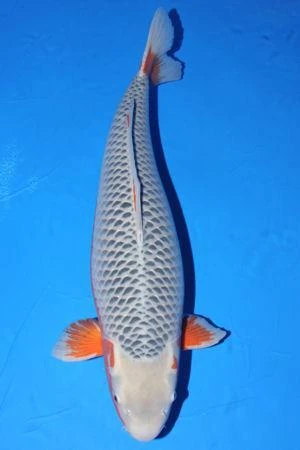
The Hi of the Asagi is most often a rusty Hi. The Asagi features the absence of Hi drawings on the back (like those that can be found on the Kohaku and Sanke etc....) a back covered with blue scales (Indigo) with white skin that appears between them and red on the belly, cheeks, at the base of the pectoral fins and at the bottom of the dorsal fin. The red at the base of the pectoral fins is called Motoaka, which is an important characteristic of the beauty of the Asagi and Shusui because these two varieties come from the same lineage.
Item 1:
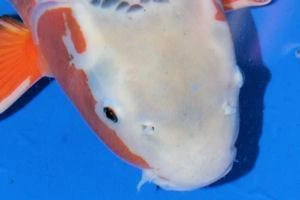
The Asagi's head must be bright white with Hi's ringed ears.
Item 2:
The back is bluish, the belly is red orange The pectorals may have Motoaka.
Item 3:
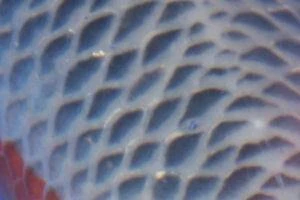
The back is blue with a cross-linked appearance (Fukurin) The Fukurin causes a net appearance by allowing white skin to appear between the blue scales.
Developments:
When young, the entire pectoral fins are red but when the fish grows, a white edge appears and spreads, the proportion of red will gradually decrease to remain between 30 and 50% of the pectoral surface. A 30% surface is considered the most harmonious in the balance of the fish.
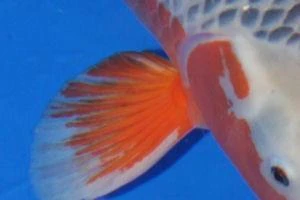
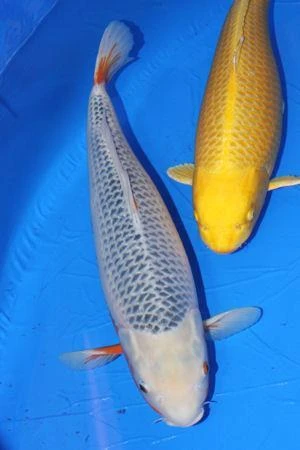
Young Asagi.
Although the red of the pectoral fins is an important part of the beauty of the Asagi, it is not absolutely necessary. The head, however, must be completely white, many Asagi heads have Jyama Zumi (group of small Sumi points) on the head or yellowish skin, which is considered a fault. The white head clearly highlights the blue colour of the back. The scales start from the shoulders towards the tail with a well marked net look. This Fukurinn-like appearance really appears only around the age of 4 to 5 years when it will have the size of +/- 60cm. It is therefore difficult to choose beautiful Tosai Asagi because it is only after a few years that their quality can be determined with more certainty.
How to choose or judge the quality of an Asagi?
1. The head shall be white without stains.
2. Hearings are surrounded by Hi.
3. The cross-linked appearance of the back must be regular from head to tail.
4. The belly is orange red.
5. The Hi does not exceed the lateral line.
The first thing to observe is the "net" aspect of the fish's back. When young, this reticulate appearance is weak and the color must be indigo blue, not too dark. The scales should be well equal and balanced. The Asagi will see its Hi drawing increase with age. If you choose a tosai that already has a lot of Hi, it risks growing up to be much too red. In fact, an Asagi is really an Asagio only around the age of three when the blue is well marked and the Fukurin starts to appear. It is only at this moment that you actually see what you have as a fish.
One important thing to observe is the nose which must be white. The head, however, can be grey because you can see the skull by transparency but it will whiten when the fish grows because the skin will thicken. When you talk about the nose, it represents the region that starts from the mouth and goes up to the eyes. Next point, look for the red that surrounds their ears, a little like horse iron, if there is none, look for red on the lower third of these same ears.
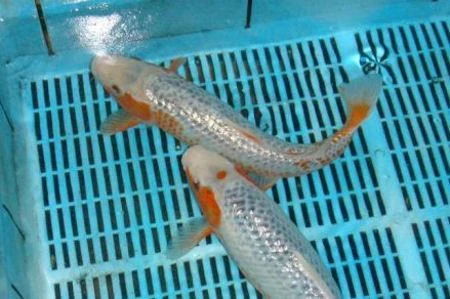
Another thing to observe is the red on the belly. The Japanese compare this red which is rather an orange red with the paint covering the keel of the boats. If the red does not already climb the flanks, turn the fish back to look at it well. The ideal would be to find a fish with white at the bottom of the belly then red on the sides but that does not climb higher than the lateral line. Avoid in any case, a tosai with Hi that goes up higher than the lateral line. Pectorals are as important, the ideal would be to have pectorals that would have red on 1/3 of their surface. Otherwise, look for pectoral ones that show a little white at the ends, normally with age, the red will decrease to reach the desired 1/3 but it is not a certainty.
The same thing for the caudal fin, there should be red at its base on a surface between 1/3 and half. The dorsal fin, however, should have a thin red line just located at its base, at the junction with the back but not higher. Avoid the fish that have red in the dorsal, this might indicate that growing the fish could become too red. One of the reasons why Asagi is not easily conserved is that water parameters are more suited to Gosanke and that this is not ideal for Asagi. A GH too high and Asagi will develop Sumi (black) marks and the white of the head will become greyish. Asagi was the first variety to be stabilized. All other varieties come from this fish. Varieties and Sub Varieties.
The Hi Asagi
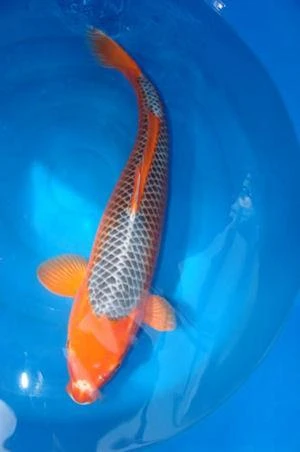
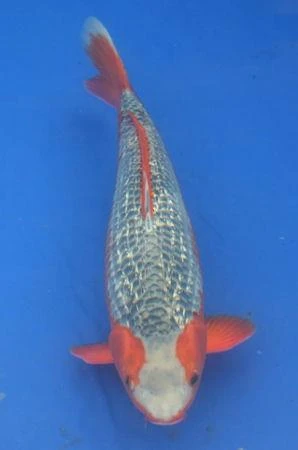
Kinginrin Asagi In this variety, Hi is the majority on Asagi.
Kinginrin variety of Asagi.
Glossary:
Motoaka:
Hi tache at the base of the pectorals, this is a negative point for a Kohaku. However, it is a characteristic of the Asagi and Shusui.
Jyama Zumi:
A package of Sumi small dots, also called Jyari Zumi or Goma Jyami. These spots can appear on the Hi as on the Shiroji.
Fukurin:
It is the small part of skin that appears between the scales of a large Koi, it gives a slightly reticulated appearance, as if a slight net was placed on the fish. Fukurin is more visible in the family of Hikarimono. At first it was thought that it was only possible with metal kkoi, but at present this is no longer the case. This term is mainly used for Ogon, Kohaku, Sanke and Showa. For others, the term "Net Pattern" is used instead.