The Changes
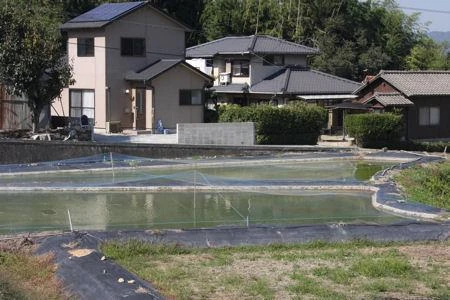
The present Nishikigoi are the result of the natural mutation almost 200 years ago of a black edible carp (the Magoi) which was raised in Japan for purely food purposes, this carp complemented the daily diet of Japanese farmers. History begins in the Niigata region, located on the west coast of the Honchu island at two hours by TGV of Tokyo, Niigata is currently a very important city in the breeding and selection of Koi. In this region surrounded by mountains, the inhabitants built rice fields on terraces to grow rice and vegetables, above these rice fields, there were ponds with water reserves necessary for irrigation of rice fields.
Magoi were raised in these reservoirs rather than in rice fields, as is often thought. They provided a food reserve for winter. One day, these Magoi suddenly mutated as a result of inbreeding: they had been confined to these water reserves and breeding among themselves for hundreds of years. Fish with different colours and patterns appeared among the black carp. This phenomenon was observed between 1804 and 1830 in Japanese villages such as Takerawa and Higashiyama, now part of Ojiya City. Around 1840, farmers, fascinated by these fish, began trying to breed increasingly beautiful and distinctive koi. Little is known about the first mutations. It is thought that a carp produced red-cheeked fish called “Hookazuki”. These fish are said to have had white descendants which, when crossed, produced the first red-and-white fish called “Hara Aka”, meaning “Red Belly”, the ancestors of today’s Kohaku. The black Magoi itself is said to have originated from two wild carp varieties, one brown-black and the other blue-black, and to have given rise to Asagi, another Magoi mutation.