
Pond Cubifilter in IBC vats
This file explains how to make a pond filter in an IBC tank. It details the choice of container, the mounting of partitions, water arrivals and purges, and then the mechanical and biological filtration supports.
Archive file Aquatechnobel on an off-ground filter powered by pump. The costs, materials and dimensions cited describe the achievements of the time.
The idea of writing this article comes from the growing interest of visitors to " http://www.aquatechnobel.be For the production of filters for ponds using plastic containers. Understanding that in a forum as active as this one, the search for perhaps long information, it seemed obvious to make a synthesis of most of the answers concerning the manufacture of a "Cubifilter".
This article will explain the manufacture of an off-ground filtration, the filter in this case is higher than the pond, it is a pump that rises water to power the filter. methods of filtration.
By taking up the most frequently asked questions on the forum, we offer you a condensation of all the interesting information that has been given over the months, they do not lack!
The principle of the Cubifilter
What is a Cubifilter?
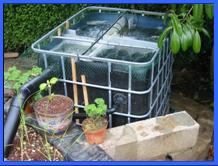
It is a filter made by amateurs from containers also called "IBC" and designated on the forum as "IBC tank" hence its name: Cubifiltre.
Here, one of the first Cubifiltre on "ATB", a superb realization by Laurent.
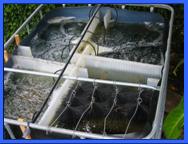
How many m³ can filter a IBC tank? The number of IBC tank for my pond?
It is admitted that a Cubifilter of 1000 liters can ensure the filtration of a pond of 20m3 without problems, and certainly more. There are several possible capacities, 600, 800, 1000 and 1200 liters, the most common being 1000 liters. If one is based on 20m3/IBC tank of 1000 liter, the calculation will be simple to make for your filtration.
Note: A filter that is larger than the necessary does not pose any problem, on the contrary! On the other hand, an undersized filter will become the cause of many inconveniences...
Choose the tank and estimate the budget
Which do you choose to make your filter?
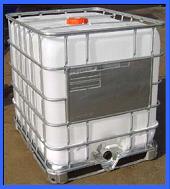
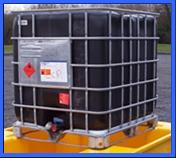
The choice of IBC tank used for food products, such as the manufacture of beverages (sirops, fruit juices), is preferred.
Unfortunately, this is not often possible, so it will be necessary to perform a careful cleaning of the IBC tank (washing, rinsing) with a high pressure jet, while avoiding, if possible, the IBC tank having carried toxic materials. Finally, the ideal solution is the purchase of a recovery IBC tank equipped with a new pocket (envelope), which guarantees non-toxic packaging and a greater longevity of the filter.
Another aspect of the question, the pallet supporting the cub can be made of wood, pvc, steel. You will rarely have the choice but the best being the pvc. The wood having the disadvantage of posing a problem for the laying of backwash, but nothing insurmountable. Can also intervene the color of the pocket, i.e. three, white, blue and black. Black seems the most appropriate since it will protect bacteria from light and ultraviolet radiation, white is the most common.
Where to get a IBC tank?
The main source for buying a IBC tank (container or IBC) comes from recycling. You have to contact this type of specialized company or know people working in companies using IBC tank, which can be sold to staff. Free classified newspapers regularly contain offers of IBC tank, the price charged is often a little high! Internet allows you to find addresses.
The cost of a IBC tank?

It is very variable and ranges from 30€ to 100€ which is really the high limit that one regularly finds on the classifieds newspapers. For information, I had 2 IBC tank with new pockets for 150€ all, passing through a company specialized in recycling containers and plastic drums. The purchase of new containers is possible but the economic interest of the operation takes a hit (+/-300€ piece). These indicative prices are those recorded in 2004/2005
How much will a Cubifilter come back to me ready to work?
It is difficult to give precise figures, the quality and the number of filter elements placed in the Cubifiltre which can vary greatly in the final slate. It is possible to estimate a floor of 300 or 400€. A comparable filter in the trade can approximate the 1500€ see much more according to the model.
Longevity of a Cubifilter?
We don't have an answer to this question. It is better that the filter is protected from the sun, the ultraviolets can in the long run make the plastic of the pocket brittle. The first IBC tank made by members attack their 3rd year and are healthy.
Materials and bulkhead assembly
What materials for partitions?
Several materials have been used and each have its own advantages and disadvantages. Others are left aside, including PVC which seems to be the ideal product but it is excessively expensive and inox, expensive also and difficult to implement in a IBC tank.
For the most employed, we can find:
The pretzel, used in the building for formwork, is very well resistant to moisture. Unfortunately, it is not very easy to buy it.
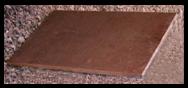
Polyfilm filmed or plywood plywood is common among construction material dealers, it is used for formwork. The price remains reasonable (250x122x18mm = ±60€/plate) I do not know the water resistance of this product. I used this material for my filter, it lives its 2nd year without sign of aging.

The polycarbonate is located in the DIY shops in the form of a plate for veranda, greenhouse. Its resistance is a little weak and any screwing is delicate. It has a very good hold in the water. It is more suitable for a 4 bedroom cub where it can be reinforced in the middle. See the 4 bedroom IBC tank of Laurent.

The Makrolon, polycarbonate in full plate, also available in DIY shops. Here too, depending on the thickness of the product, it may be possible to use it to make large partitions. Used by Hervé "rvjal" on its 4-bedroom Cubifilter, opposite.

What silicone to use?
There are many products:
- The TEC7 seems the best choice. Very well distributed in Belgium, I don't know anyone by having found it in France. However, this product must exist but under what name? For information about this product: Novatech
- The Rectavit 170
- The "special aquarium" silicone, inexpensive, however, gives an average result for adhesion on the walls of the IBC tank.
- Other "special marine" products can be used, check that they are not harmful after drying
The water course
How does a Cubifilter work?
Well, it works like a multi-chamber filter! But still!? A little sketch is better than a long speech! !!
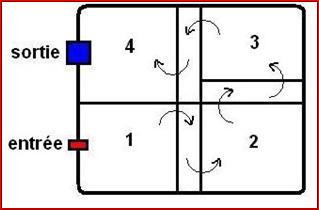
The principle is to pass water through different materials (masses or filter media) to filter water from the pond. This water will pass through the filter masses from bottom to top, what is called "up-flow". To do so, it is necessary to place partitions in the filter to obtain this movement of rising water.
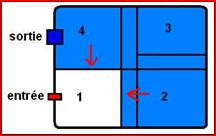
Let's take the diagram of a 4-bedroom Cubifilter: water comes to the bottom of bedroom number 1, ascends to overflow over the 1st bulkhead. Water will then pass below the next bulkhead to come out at the bottom of chamber number 2. This mechanism reproduces in each chamber of the filter.
How do I design his Cubifiltre?
After determining the number of cubs that will compose its filtration, we can imagine several interior arrangements of the filter. No rules are fixed and everything is feasible or almost possible.
However, some leads can be given based on the achievements of Forum members who are not lacking in ingenuity and know-how.
We're going to take a look at these achievements with the help of small sketches.
For a cubThere are three possible solutions that are already being implemented by Forum members.
the Cubifilter with 4 bedrooms, the most classic, the one drawn by Serge "Artgraphbegain"
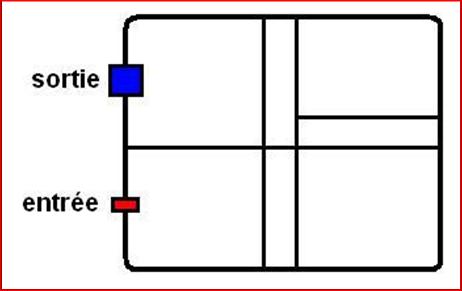
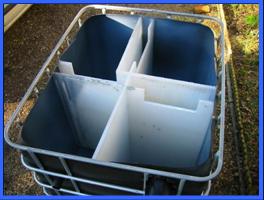
A variant that does not lack interest and originality. It is simpler to build at the level of partitions but less efficient in my opinion (distribution of flow, settling) However, one thing to avoid absolutely.
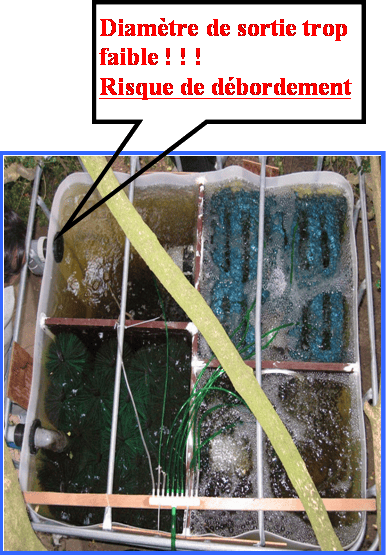
The filter of "Remi"
The very good oxygenation of the biological filtration chambers is essential for the bacteria and the efficiency of the filter.
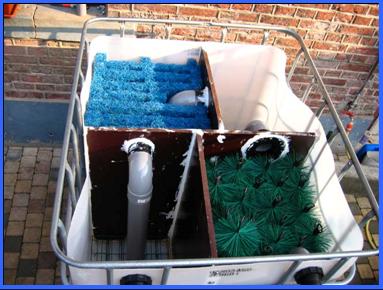
The 3-bedroom Cubifilter, a little simpler in the cutting of partitions
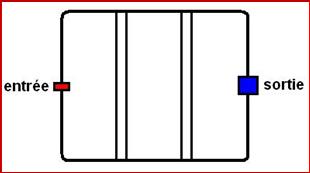
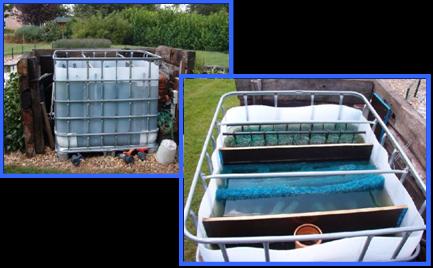
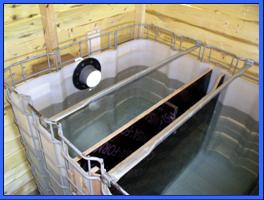
The Cubifiltre has 2 bedrooms, the construction is still simplified.
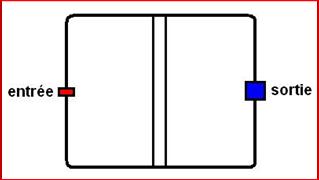
What is their respective effectiveness?
Hard to say, it is well known that it is good to put several kinds of filtering media in order to promote the colonization of different types of bacteria and that partitions favour a better circulation of water. Then it is a question of address for realization, each with different abilities at this level.
For two IBC tank, there are two solutions
The double Cubifiltre 4 bedrooms, the filter I use for my 43m3 pool
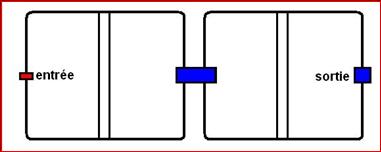
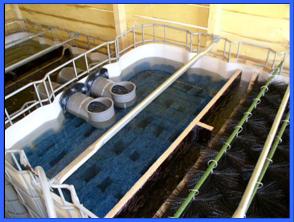
The double Cubifiltre 2 bedrooms, simplified implementation to the maximum
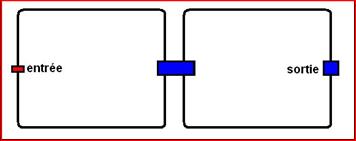
The "4 bedrooms" seems to me more efficient, better water circulation in the filter and possibility of placing several different filter masses, however it is less easy to do. The advantage of the "2 rooms" is its simplicity and speed of realization.
One can think of a third solution with a "6 rooms", no one has yet done it. It further complicates the realization in relation to the "4 rooms".
For 3 IBC tank and more, the problem is the same as for two, however the solution is simpler, each cub forms a room, with the possibility to divide each cub into 2 bedrooms, something that no one has yet done.
A hell of a filter for a 40m3 tank!!
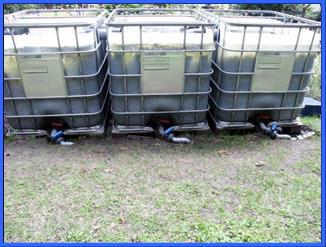
Same design as above with in addition the peculiarity of having each cub staggered in height for better water circulation.
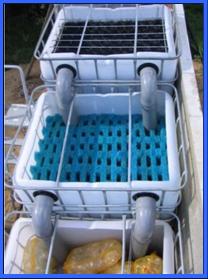
Very comfortable filtration for a pool of 60m3.
Note the volume of Japanese filter matting in the 2nd bedroom as well as the bags of biobottles in the next.
This filter is now placed in a shelter that protects it from UV and weather.
After this overview of the different configurations, the next chapter will go into more detail in the manufacture of the Cubifiltre.
Construction of the Cubifilter
After reading the previous chapter, you can have a pretty accurate idea of what's ahead of you. Here we are in the heart of the subject, you have chosen the configuration of your filter, there is more than just to roll up your sleeves...
Above all, it is useful to recall that a Cubifiltre is large and will require an arrangement to camouflage it.
The first intervention is the cutting of the cub. It is a very simple operation with the use of a grinding machine or a jumping saw. The cut is debunked with abrasive paper.
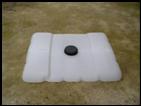
Careful cleaning of the cub is essential in the vast majority of cases, this is the time to do so, the cub being empty and easily accessible.
NB: We will take the case of a 4-room Cubifilter to explain the operation and if necessary, we will bring details for the other filter models.
The laying of the backwash pass-parois
Backwashes are used to dispose of waste that is deposited on the bottom of the filter.
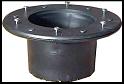
! ! ! All interventions at the bottom of the IBC tank are made before laying the walls for reasons of accessibility.
The wall pass is placed at the centre of each filter chamber.
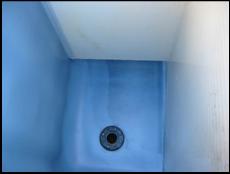
An idea expressed on the forum: replace conventional wall passes with bottom bottom drains to improve sludge aspiration. It's more expensive but it's much more efficient.
Interesting no!!!
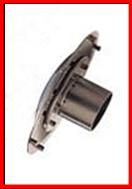
Another solution, the one implemented by "Imkal", which allows to have the advantages of the bottom drain but using a classic wall pass.
A disc supported by spacers comes to suck the wall pass to cause a side aspiration of sludge and to improve very clearly the efficiency of backwash. The cost is tiny and the improvement is consistent!!! Thank you Patrice!
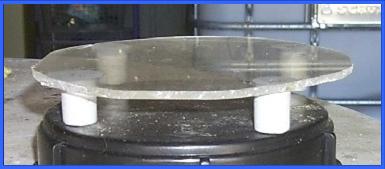
This sketch shows the layout of the "hat" above the wall pass. A height of 10 to 15mm is sufficient for the spacers, in order to have an acceleration of water (same phenomenon as skimmer) and allow for the widest possible suction zone.

In the case of large rooms, i.e. one room per IBC tank, it is better to put 2 backwash per room.
How many arrivals for my IBC tank?
If you have a skimmer (photo on the right) or want to equip your pool later, it takes two arrivals in the Cubifiltre.
The simplest way is to place 2 wall pass on the cub, mini diameter 40mm, recommended 50mm
How can I make my water come into the IBC tank?
"We put the arrivals down so that the water goes up in the brushes," you think!?
This simple solution that many (and I too) have adopted has two important disadvantages:
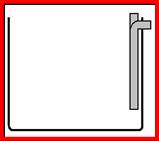
1st) In case of shutdown of pumps, on an electrical failure for example, the water contained in the first chamber will return to the pond by siphoning. This creates a risk of breakage of the bulkhead due to the efforts caused by the difference in level with the neighbouring rooms.
On the sketch, room 1 is almost empty.
2nd) Water entering the lower part of the chamber causes a significant stir and reduces the settling of suspended materials. Decantation is an element conducive to the efficiency of filtration. You are warned of the disadvantages of this solution, which however has the advantage of simplicity.
What alternatives?
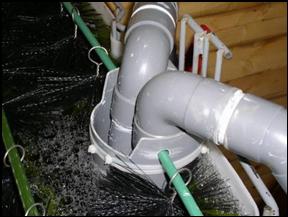
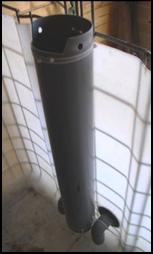
(a) A pipe of 100mm or more is placed which descends to 15 or 20 cm from the bottom. At the top of this pipe, a 100mm "tee" on which the arrivals come to connect via a reduction of 100/2x40mm. This pipe passes over the cub or through a wall pass, it is up to you to choose... There will be no more siphoning and the settling will be slightly improved.
(b) Setting up a bulkhead that will remove water at the bottom of chamber No. 1, over the entire width of room No. 1.
The result is double, there is no more siphoning, as in the previous solution but in addition, the settling is greatly improved since the water speed is much lower in the bottom of the cub and the flow is less turbulent.
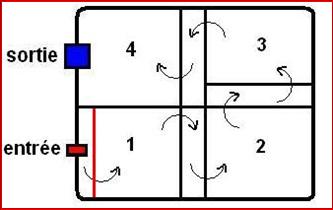
To sum up, the most effective solution is this one
Take advantage of this to review the operation of a filter
In this diagram, I have only represented two rooms so that it is more readable. It does not change anything on the principle of filter, the passage from one chamber to another always performs in the same way.
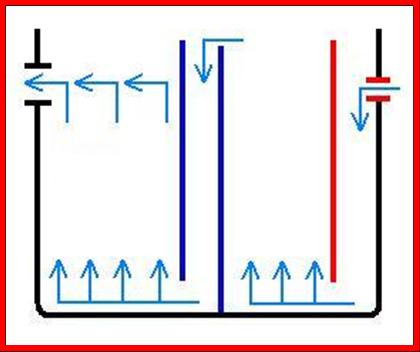
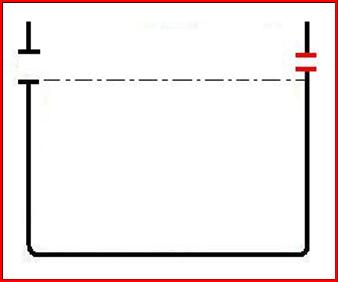
I think, after discussion on the forum, that the best thing is to place the entrances slightly higher than the exits, in order to avoid a return to the pond in case of shutdown of a pump (when filtration involves 2 or more).
The installation of partitions
Probably the most delicate work of this construction!
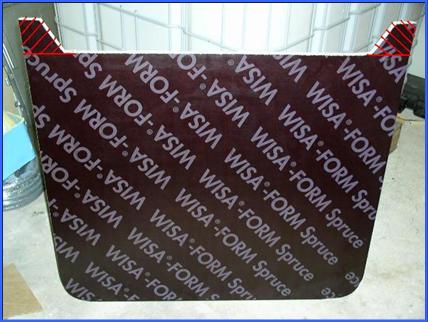
For a 4-bedroom Cubifilter, the drawing of partitions is a little complicated, the goal is to do this.
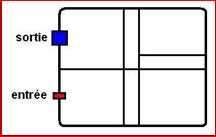
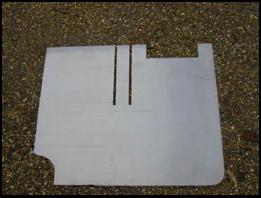
At the bottom right, you can see the small rounding made in the corner between the bottom and the wall.
At the bottom left, this is the rounded cut that takes the shape of the rounding where the bottom valve of the cub is placed.
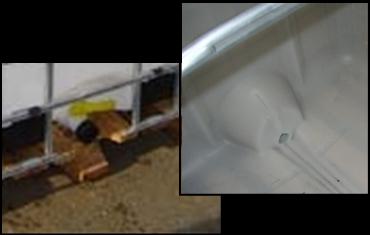
At the bottom right, you can see the small rounding made in the corner between the bottom and the wall.
At the bottom left, this is the rounded cut that takes the shape of the rounding where the bottom valve of the cub is placed.
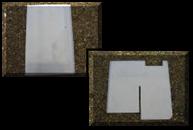
The height difference between partitions may be much smaller, 2 or 3 cm sufficient.
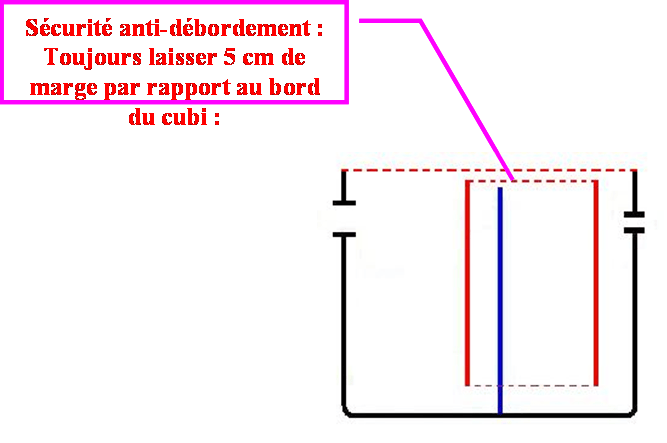
It is not necessary to make "ears" on either side of the top cut of the partition, I think it is even harmful to good water circulation.
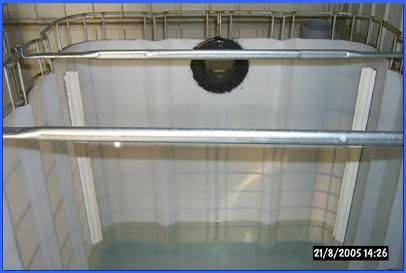
Imkal, again he, offers us a simple solution to make a partition. He uses PVC panelling threaded in two rails that are glued to the wall of the cubic.
However, the low pressure resistance of this installation reserves it to the chambers where there can be no difference in level on either side of the partition. It would not resist!
This solution is therefore quite appropriate to make the bulkhead when the cub arrives!
Some photos proposed by Patrice "Imkal"
Here, the two rails glued on the cub. It is obvious that a gluing of very good quality is necessary.

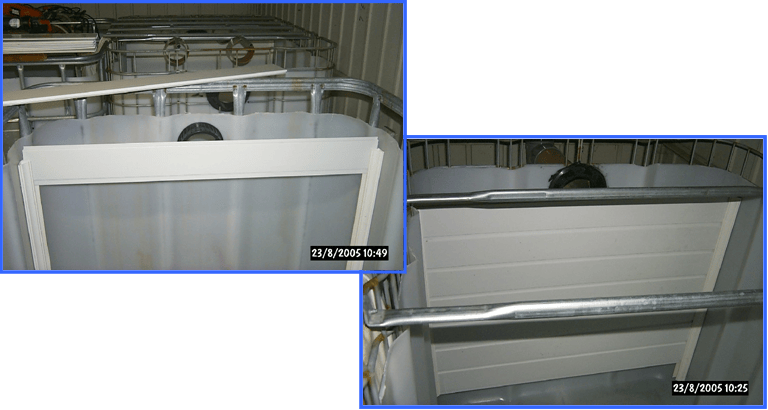
Then simply thread the panel blades into the rails and stick them to the desired height. and perfect sealing.
Simple, fast, inexpensive, what more does it take?

In IBC tank where there are several chambers, the walls must have a good resistance since significant differences in levels can occur, especially during backwashes.
Solid materials and fasteners must therefore be used on the walls.
A simple solution, depending on the thickness of the wall, is to hold the partitions by screwing through the wall of the IBC tank.
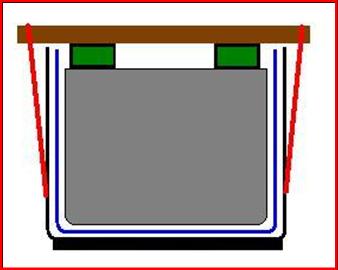
First of all, copiously top with silicone the slice of the bulkhead that will be in contact with the pocket of the cub, the sealing of the mounting depends on it...
It is imperative that the bulkhead be properly plated on the bottom of the pocket before screwing.
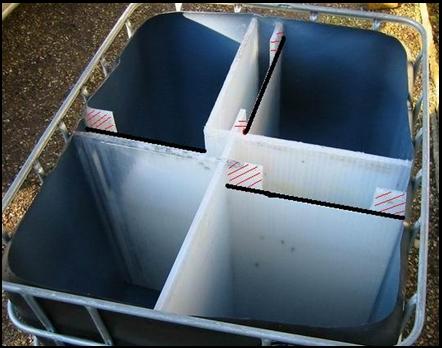
To do this, one can use cliquet straps (red) passed through the cage of the IBC tank (black) which "braking" a wooden cup coming to lean on holds placed on the partition to be fixed.
A very strong hold is thus ensured and your hands are free to continue mounting.
Depending on the material used, its strength, its thickness, we will choose a suitable type and diameter of screws
In the photo opposite, it is "filmed plywood" 19mm thick.
The wood screws are 5mm in diameter and are mounted with 2.5mm foreholes.
Before screwing, silicone is injected copiously into the hole.
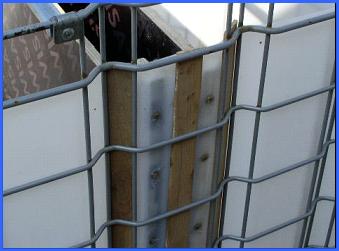
For "makrolon" polycarbonate or PVC, it is necessary to provide the taping for screwing in this type of material.
How far from the bottom of the IBC tank is the bulkhead shut down?
It takes about ten centimetres of space between the bottom and bottom of the bulkhead.
How far from the top of the cub does the bulkhead stop?
It is reasonable to provide a margin of 5 cm so that the water can pass over the bulkhead in the event of sealing (butchering) filter masses preventing water from passing under the bulkhead.
What difference in height between two successive partitions (for up-flow)?
2 or 3 centimetres seem sufficient, i.e. the bulkhead where there is a water overflow will be 2 or 3 cm lower than the next bulkhead, the one where the water passes below.
The gap between the two bulkheads?
10cm
Filtering Masses
The filtering masses, what is it?
As we have seen, they fill the chambers with a filter to hold the particles transported by water and serve as supports for bacteria that will ensure biological filtration.
It is therefore distinguished by mechanical filtration which ensures the capture of suspended material in water and biological filtration for the treatment of ammonia, nitrite, etc.
The cost is high and represents the most important item in the manufacture of a ubifilter. After an overview of the commercial offers, we will see that it is possible to make itself the bacterial media,
Here's a link to an article, about filter media https://aquatechnobel.blog/2023/01/17/masses-of-filtration-or-medias-of-filtration-biological/
The filtering masses that can be made by yourself:
biobottles, a real star, a find of a member 20 of ATB. They are made with bottles of mineral water that is cut into a ribbon of 5 to 10mm wide. It is the free support par excellence. But it takes a lot of patience and perseverance to fill a room of Cubifiltre. They are effective.
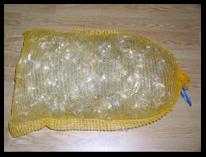
The bioficells, imagined by "Toff" still a member ATBs. Here the polyamide string (I believe) recovered from farmers.
Biogains, are made with electrical sheath cut into pieces from 30 to 40mm.
With these three almost free materials, the filter budget becomes reasonable for a serious filter quality.
In this type of filter, it is recommended to avoid anything that colmates quickly, such as foams for example.
The only absolutely essential purchase is the filter brushes!
CONCLUSION
The ATB team hopes that the reading of this dossier will have answered a large part of your questions if it does not answer all of them. This document is not written in marble and will be updated regularly as the members of the forum find and comment on it.be The forum is at your disposal to collect your ideas or answer your questions. Thank you for reading! The team of Aquatechnobel.