In concrete terms, how to cycle a pond?
You can cycle a pond without or with fish. To be clear, it is much better to cycle a pond that is not populated by any living beings so as not to cause your fish to suffer toxic levels of ammonia and nitrites. However, you may find yourself in a situation where there is no other choice, for lack of information before. We will also explain how to cycle an aquarium that already contains fish. In this way, the operation will take place in the best conditions.
Cycling a fish-free pond
Fish-free cycling makes it possible to prepare the biological filter before introducing the koi.
Step 1: produce ammonia
Use ammonium chloride for cycling, following the product package leaflet and taking into account the actual volume of the pond. Measure the TAN to check the dose.
Step 2: Test the ammonia level
Calculate NH₃ from TAN, pH and temperature
On startup, aim 1 to 2 mg N/L of NA, only in a fish-free pond. Check the unit indicated on your test and measure the TAN every day.
Follow the decrease in TAN and the rise of nitrites. For any new intakes of ammonium chloride, follow the product protocol and take into account the measurements already recorded.
Step 3: Test nitrites.
Follow the nitrites (NO₂−) at the same time as the TAN to observe their appearance, then their decrease as the filter is set up.
Step 4: Test nitrates.
Also follow nitrates (NO₃−) to observe the evolution of nitrification. The duration of cycling depends on the conditions of the pond.
The cycle is almost over.
The filter is ready for a progressive introduction when both the TAN and nitrites return below the detection limit after an ammonium intake according to the cycling protocol.
Step 5: Add the fish.
Before introducing the first fish, check again that the TAN and nitrites are undetectable and that the other water parameters are suitable for koi.
Add fish in small groups and control the TAN and nitrites before each new introduction.
The population of bacteria is still fragile and will not be able to cycle your pond quickly if you add many fish at one time.
Cycle a pond with fish
This is absolutely not the preferred method. , but you may no longer have a choice in case you already have fish in your pool, in your swimming pool, or in case you want to enlarge your pond. Your fish will be exposed to toxic substances and they may fall ill or die from it. Do so only if this is your only option.
1: Feed your fish very little.
Your fish will naturally produce the waste necessary for the cycle. Feeding them would increase the amount of waste and increase toxicity. Fish can live months without food, so feed them every three days without causing high waste production.
The meal should be eaten immediately to prevent rotting in the water.
The aim is to control ammonia production until the bacteria that feed on it appear, and thus avoid a peak of ammonia that would be fatal.
2 : make water changes.
Adjust the frequency and volume of water changes to TAN and nitrite measurements and fish condition. Check the pH and temperature of the replacement water, as well as the possible presence of ammonia or chloramines. Use properly dechlorinated water. Merck Veterinary Manual.
Check the TAN and nitrites again after renewal to decide on the continuation.
3 : Check the levels of toxins.
Measure TAN and nitrites every day during cycling with fish. Continue to monitor the TAN in routine maintenance and bring the measurements closer if it becomes detectable. University of Florida.
Also follow the nitrates to adjust the pond maintenance.
The filter stabilizes when the TAN and nitrites remain undetectable with the fish present.
At this moment, the hardest will be done!
Can we speed up cycling? If so, how?
Yes, the nitrogen cycle can be accelerated.
By the introduction of bacteria.
If you don't want to wait more than a month, you can use these techniques.
These tricks will not allow you to have an instant cycling, but to reduce the duration of it.
Arm yourself from your nitrite/nitrate tests and monitor the rates so you don't rush!
Use live plants
Live plants, not fake plants, can help introduce bacteria to help speed up the process. Especially if you take them from a roded pond.
Plants bring beneficial bacteria, but they mainly play a role in cycling by absorbing nitrates. Prefer fast growing plants.
Solving common nitrogen cycle problems
Ammonia poisoning
This is a serious threat to your fish if you cycle a pond in which fish are already present. The symptoms to watch are as follows.
Lethargy and immobility;
Loss of appetite;
Inflammation of the gills, eyes;
Fish breathe on the surface.
If the fish breathe on the surface, become lethargic or stop eating, quickly check the TAN, pH, temperature, nitrites and dissolved oxygen. Adapt water changes to the results and quickly ask a veterinarian for advice if the fish show signs of distress.
Level ammonia or nitrite does not decrease
If you find that the level of ammonia or nitrites does not decrease after a few days, it is likely that bacteria that feed on them will not be able to settle.
Check the flow and oxygenation of the filter and preserve its biological masses. Adjust water changes to fish measurements and condition.
I've got an algal explosion.
Your pond can suffer from an explosion of algae during cycling. Algae quickly took advantage of the explosion of nitrites and nitrates to develop.
Second, the only way to fight algae sustainably is to compete with them by adding plants, especially fast growing plants.
Conclusion
The nitrogen cycle continues in a mature pond. Regularly control the TAN, nitrites and nitrates to detect malfunctions.
Maintain sufficient oxygenation of the pond and biological filter during cycling.
Thus, as we have seen, plants can contribute to the purification of the pond.
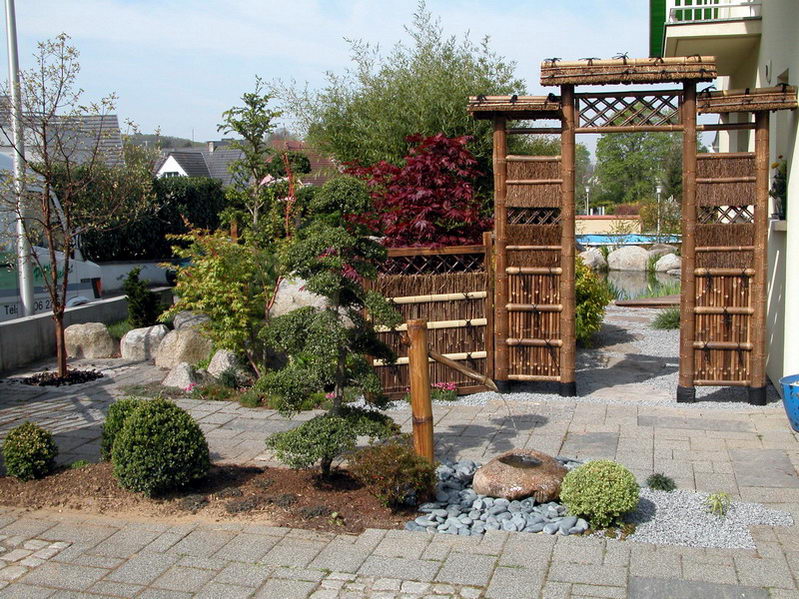
The question: "Will the pond be planted or not?
It all depends on the type of pond; in a pond without -or containing few fish, the plants will do the work.
In the case of the landscaped pool containing fish, plants will work in addition.
Indeed, they can only absorb nitrates during their growth. After the growth, in fact, the phenomenon ends, which means that for this type of pond, plants will be a complement to a conventional filtration.
Don't waste water during changes, nitrite water is ideal for garden watering, it is a very good fertilizer that acts slowly and it is beneficial to your terrestrial plants.