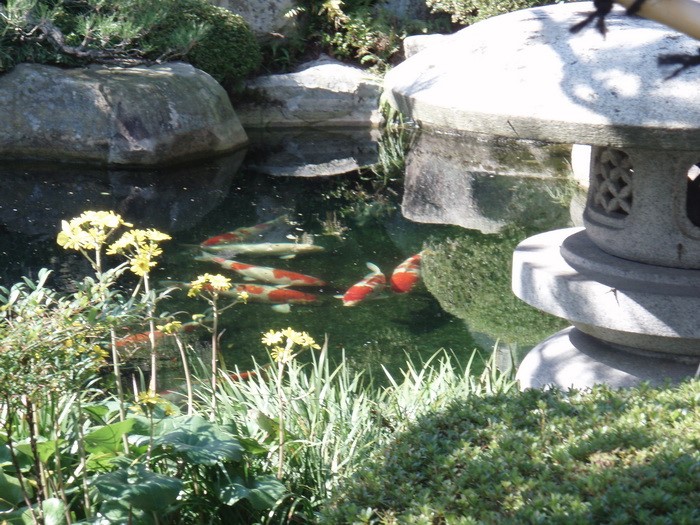
Watertightness: the different possibilities
The sealing solutions presented in the original text, from the preformed shell to tarpaulins and bowling products. For installation and warranty conditions, see the manufacturer's documentation.
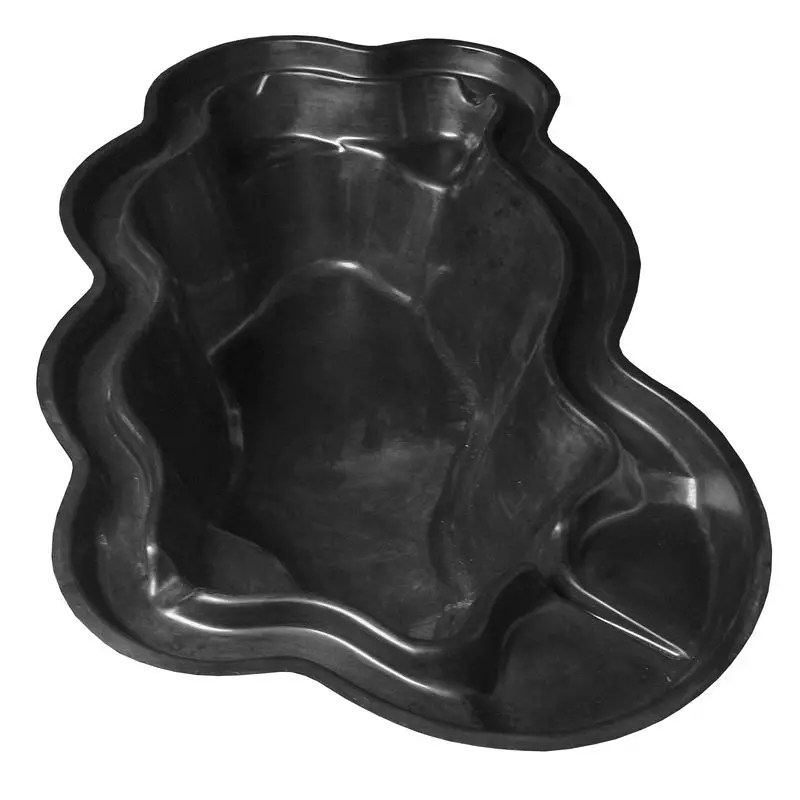
The preformed pond
You will have the choice between preformed ponds of all sizes and shapes.
The advantage of this type of resin, PVC or HDPE pond is that all plantation areas are provided from the start.
Another advantage is that it can be used above ground if it is of good quality. It then becomes ideal for the layout of a terrace or for that of an indoor pool.
The disadvantage is its implementation. Indeed, placing such a pond is not easy contrary to what one might think! Then the camouflage of the apparent banks is not simple to achieve (There is often apparent polyester left).
If you opt for this type of pond, make sure it's self-supporting, that means you can fill it with water off the ground without causing any damage.
Indeed, there are a number of low quality hulls (PVCs) that do not support such treatment.
It is important to know that, even if you follow the instructions of placement in the letter, it is not impossible for the land to move (e.g. after heavy rains) and this would be an insured disaster!
If the pond is made of polyester, it can be repaired (it won't be easy but it will be possible!).
If the pond is made of PVC, it's even more difficult, if not impossible.
Since these ponds are expensive, you should be well informed about the type of material and the duration of the guarantee on site, as moving is impossible. It should also be checked that it is self-supporting.
Do not think that it is easy to place such a pond. This method of placement is quite difficult to achieve. Indeed, you have to dig a hole larger than the pond, then place it in the hole, make sure that it is level and, finally, with sand, fill the space between the pond and the hole.
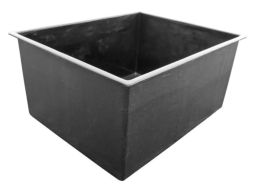
The reinforced polypropylene pond
This type of pond is suitable for a rectangular pool.
It is reinforced with metal tubes that are drowned in the PP to protect them from corrosion.
This pond is very common in Holland due to the small size of the gardens.
It is delivered by truck and can be put into water quickly.

Concrete
This material is no longer widespread today because it requires specific know-how.
In addition, its placement requires major work and it risks cracking under stress in case of heavy frosts, which explains its high price.
The concrete shall be supplemented with a water-repellent product and reinforced with a lattice to minimise the risk of cracks.
This requires experience in applying these laying techniques!
Clay
A 20 cm layer of clay can also act as a waterproofing layer but it is necessary to have perfect control of this type of material.
Although it is appreciated by ecologists, I do not recommend it to amateurs because of the difficulty of implementing it. Indeed, its placement requires the availability of heavy earth-moving equipment, but this is not the case for everyone.
Small precision: its price is very high!

Bentonite
Bentonite is an effective material but is suitable only for clay soils.
Particularly inflating, bentonite takes up its volume several times in contact with water.
This material is completely inadequate for a calcareous soil; its sealing is not total and it permanently loses water, in the best case, about 10% of the volume of the pond per day.
It is therefore imperative to have a small water source nearby.
Without this opportunity, it is quite impossible to envisage the use of this type of watertightness.
Bentonite comes in powder form. It is spread over clayy soil and is amalgamated with the help of a motoculturer. I specify that it is illusory to believe that you can do this work by hand!
After watering, if you notice a very large leak, it is possible to seal it by sprinkled the surface of the water with bentonite. The latter alone will find the leak.
This operation should be renewed every 6 months.
As we see, this system is not very practical and requires many interventions.
And this finding is all the more real if the pond is planted, since the root system of plants favours leakage!
Polyester cast on site
Obviously, polyester is the ultimate nec no longer. If you choose this material, I recommend that you have it placed by a professional who has a perfect knowledge of this product.
It is important to know that when placed, polyester can be very harmful to humans!
Advise yourself: Before committing yourself, ask to see what this professional has achieved.
The advantages of polyester
The on-site cast polyester makes it possible to give all the imaginable shapes to your pond.
Other major assets: it is very resistant, easily repairable and has a great longevity.
In the past, the technique used was to line the hole with oiled paper (Craft paper) on which polyester was applied.
But this technique showed its limitations: polyester was found to rot outside the pond due to water infiltration into the earth.
Today, the technique has evolved and is much more demanding than in the past.
Indeed, what are the constraints?
Polyester resin comes in the form of a syrupy liquid that contains polyester chains as well as styrene.
Unsaturated resin (liquid) polymerizes to become solid (it is said to become saturated) during stratification.
To polymerize, the resin must be mixed with a catalyst (hardener), i.e. pre-accelerated polyester resin, low styrene emission and optimal quality to ensure the sealing of your pond.
It takes from 1.2 to 1.4 kg of resin to properly soak 1 m² of glass fabrics 450 g/m².
With glass matt of 300 g/m², count 0.8 to 1.2 kg of resin per m².
Plan two layers of glass mat and two layers of resin for a pond laminate.
To achieve a polyester seal, the ideal temperature is between 14° and 20°. Below 14°, polymerization takes place slowly. Above 22°, the working time is significantly reduced but possible.
In any case, avoid applying resin in the sun!
How to proceed?
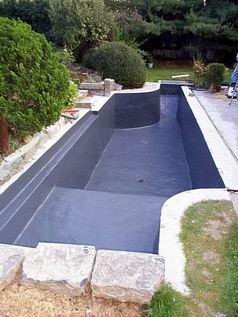
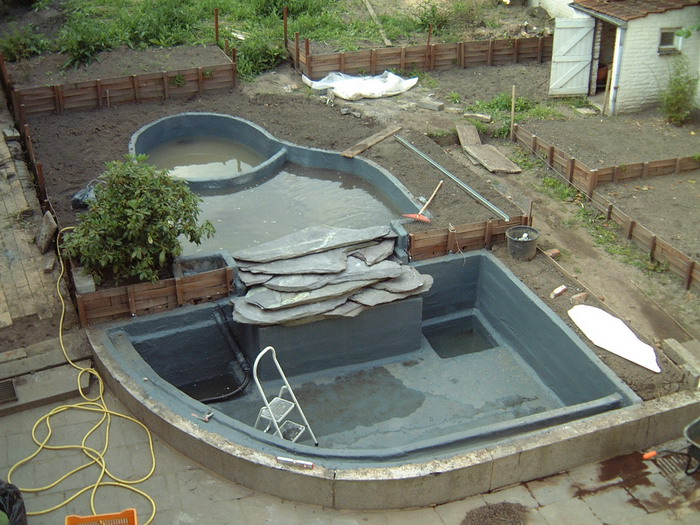
To begin with, you have to concrete the entire pond: the bottom in the first place then, the walls can be made with parpaings.
Next comes the treatment of the floor and walls with G4. It is necessary to seal the outer face of the polyester in order to avoid its rotting. Third, the polyester is applied. This operation is carried out in several stages: The preparation of the construction site: the strips of cloths are precut. Then we mix the two components of the resin. Be careful! You have on the one hand, the resin, on the other hand, the hardener, and the quantity of it depends on the temperature. This work requires the craftsman's know-how because if you put too much hardener, the resin will be inapplicable, if you do not put enough, the resin won't dry and you won't be able to perform the final step.
Next, a strip of glass canvas is placed which is coated with resin using a brush.
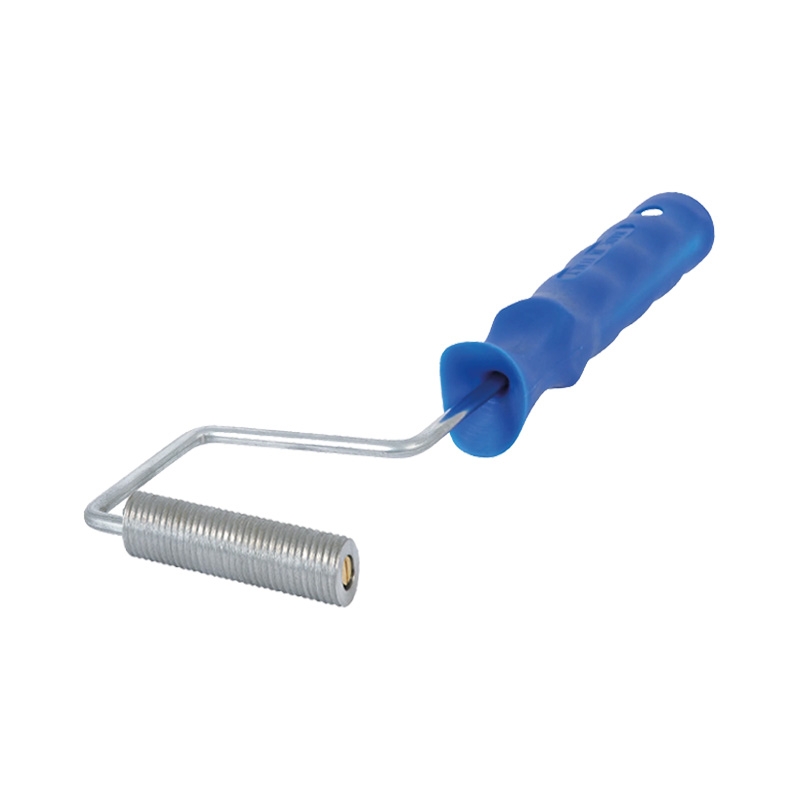
A very important step is to wrap the coated cloth with a special roller (bubble) dedicated to this purpose. Then, we place a second layer of glass canvas that will be debulled, too. I warn you: after these operations, you will look like a puppet of the "Muppet show"!
After drying the whole, comes the sanding which aims to remove the asperties and small needles from the glass web that appeared during its de-bulking.
Last step: apply a top Coat that is a kind of paint, to complete the seal. Indeed, polyester is not waterproof without this top Coat! As you can see, these many operations must be carried out with great care!
That's why I renew my advice: address yourself to a professional who knows these techniques perfectly, this precision is all the more relevant as the raw material used is not given!
The cost of polyester
This material is expensive to implement. However, if your budget allows you, do not hesitate, it is the ideal product provided that your pond is not permanently in water.
The life of a polyester is about 10 to 15 years but it is repairable, which is very important.
The geomembrane (or tarpaulin)
There are different types of geomembranes:
PVC (vinyl polychloride)
In general, it is very cheap. As far as its thickness is concerned, you will find 0.5mm tarpaulins but you should choose one of 0.8mm because the first one is not suitable for a pond.
The disadvantages of PVC: this material is not UV resistant and it becomes brittle in cold weather and in the long term.
Its implementation shall be carried out at a temperature greater than 10°C.
Avoid tarpaulins that are too cheap because they are made from recycled PVC. Moreover, their longevity is very short and they release PCBs.
From an ecological point of view, this is certainly not the best choice!
In conclusion, the only advantage of PVC geomembrane is its price.
The laying recommendations are the same as for EPDM. (See below)
PE (polyethylene)
This type of tarpaulin is being used less and less.
It is a relatively rigid material, it is UV resistant, does not release PCBs, but the tarpaulin is shiny because of UV protection.
Repairs are almost impossible to make by an amateur because it must be soldered hot.
There is a variant of this product: the tarpaulin consists of two outer layers and an inner net. Therefore, it is impossible to repair or solder it.
The EP has a lifespan of 6 to 10 years.
Butyl
Elastomer resistant to low temperatures and UV. It is very elastic.
Its major drawbacks: its price and the difficulty of obtaining it.
This product is hardly used for the pond!
L-EPDM (ethylene-propylene-diene monomer)
This, in my opinion, is the best choice for anyone who wants to build his own pond.
It has many advantages:
It is very elastic.
It is resistant to UV and low temperatures.
It can be placed in low temperature.
It is environmentally friendly.
It is easy to repair; by vulcanization, it is as simple as placing a rustine on an air chamber.
In conclusion, EPDM is the ideal product because it has the best price quality ratio.
The EPDM is available in all sizes, even for very large ponds.
The guarantee is usually 10 years but some manufacturers offer up to 60 years of warranty (in Holland, in particular).
Attention: a 60-year guarantee is prohibited by European legislation! You cannot give a guarantee that covers more than one generation.
Firestone gives a total warranty of 10 years and a 20-year second regarding the stability of the 的Firestone Pond Liner's tarpaulin against UV.
The normal life of the membrane is +/- 50 years, it's proven!
Companies that give huge guarantees are, in general, unreliable. They offer a 60-year warranty for types of tarpaulins that, in reality, have a real life span of 5 to 10 years.
With a lifespan of 50 years, the EPDM still leaves you a little time before performing "a big intervention".
However, I specify that it appears that the EPDM is attacked by a parasite, to date not formally identified. The latter gradually disintegrates the tarpaulin with, as a result, a loss of watertightness of the pond.
Note: When this happens, the manufacturer no longer guarantees its product!
Precautions for installation
Always use a geotextile to cover the pond before laying the tarpaulin. This geotextile is designed to avoid drilling the tarpaline in case of rock or roughness of the ground.
For very large ponds, use degassing sleeves to prevent methane bubbles from forming due to the degradation of organic matter under the tarpaulin.
This measure will prevent you from going back to the surface of the water if a gas pocket forms between the ground and the tarpaulin.
For small ponds, I advise you to give them the shape of a boat hull.
Avoid flat bottoms and, above all, convex bottoms which, as with large ponds, would form a big gas bubble that would cause the tarpaulin to rise to the surface of the water.
Knowing that the tarpaulin weighs about 1kg per square metre, you will quickly have 100m2 for a small pond. As a result, ask for help from friends to place it.
Do not engage in this task one day of great wind because, even with the help of friends, you will not be able to hold your tarpaulin if the wind takes in, which would force you to go and look for it from your neighbor!
If such a disaster happens, you will only have to hope that she has not suffered any damage in the adventure and that your neighbour will not hold you to it!
Finally, when the tarpaulin is laid, paste the folds. It's a often forgotten step!
It is important to know that in a fold, anaerobics that are pathogens for fish multiply, which generates diseases. At your supplier, you will find special double-sided strips to glue the folds.
If you have opted for the gravitational mode, it is time to place the bottom bottom drain(s) by following the procedure I will give later. Similarly for wall passes.
Finally, fill your pond. Gradually do so by pulling the tarpaulin in order to minimize the appearance of new folds.
And here you go, all you have to do is finish the surroundings and the decoration!
How to calculate the size of the tarpaulin?
The formula is simple:
In the case of a geometric pond
For length 2 x Height +1 x Length + 50cm
For width 2 x Height +1 x Width + 50cm
In the case of a pond with bearings, the simplest is to take a string that you make follow the shape of the pond and that then you measured by adding 50cm for length and width.
Calculate the size of your tarp See all calculators
HDPE (high density polyethylene)
High density polyethylene, available as sheet or plate.
Its lifespan remains undetermined for more than 50 years.
This material is used for the construction of water châteaux or vats intended to contain acidic products.
It is totally indestructible except in case of plane crash or bombardment!
Note: special tools are needed to solder it because such work is not within the reach of amateurs.
HDPE is an ideal material, mainly in a very wet or even flooded terrain.
Its price is not given because companies that control its placement are rare.
Watch out for scams!
The swimming pool liner
This material is made of PVC but it is treated against UV.
So it's a good choice!
As with HDPE, a professional should be employed because specific tools are essential to heat it.

Vulnerable products
There are many on the market, however these mean that your pond is masonry and coated.
The lifespan is very random depending on the product used. It seems that SIKA products have the best fit in time.
What attacks these products is the formation of algae that degrade this type of seal.
Beware of liquid rubbers, these can form bubbles that contain anaerobics! when these bubbles burst, they would pollute your pond and you would have a big health problem inevitably resulting in the death of all the fish in the pond.
Conclusion
The choice of watertightness of your pond will depend mainly on your budget and the nature of your soil.
Your decision will be personal because it is impossible to put me in your place!