
Definition of pond types
From the natural pond to the koi pool, each type of pond combines a different place for plants, fish and filtration.
The pond
The pond
A pond is a "natural pond" by definition. It has the particularity of imitating a point of wetland that can be found in nature. It does not contain fish, in general. It is possible in clay soil to increase its waterproofness. To do so, bentonite can be used, but only in clay soil! A pond has no associated techniques; a simple hole of 30 to 50 cm will do the job. Over time, it will become an oasis for birds, batracians and other animals. It will be a place to observe nature with curious children to learn to live in the natural environment around them. Little nod! The pond, however, has a not negligible negative point; it must be remembered that a stagnant water point is a kingdom for mosquitoes. A tube of cream will obviously have its place in your pharmacy! Later, inevitably and without any human intervention, the pond will become a peat bog thanks to the decomposition of the plants that live there.
The small landscape
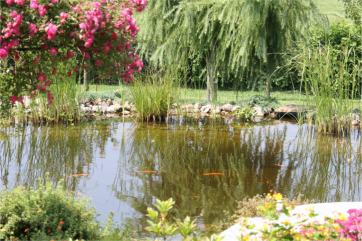
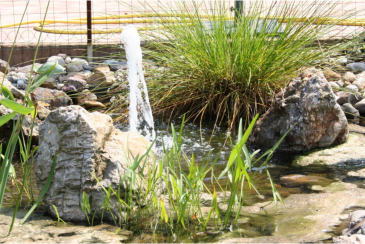
The small landscape pond is probably the most common type of pond. It may contain a few fishes: goldfish, Sarasas, Shubunkin, Gambusies ... We will place either a small biological filtration, or a lagoon, or both. The fish will be very little fed. We will welcome aquatic plants, a small waterfall, a fountain or even a small river. To ensure a good waterproofness, I recommend an EPDM (or PVC) tarpaulin which, given its attractive price and the ease of placing it, is most commonly used. For its implementation, there will be some rules to follow if you do not want to commit error(s).
The landscape pond with koi
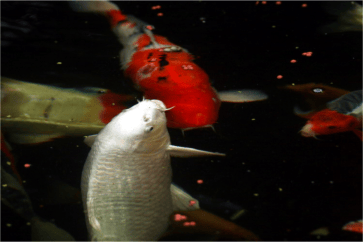
Here we change the category of pond. Indeed, this type of pond is comparable to the landscape pool if it is that the filtration will be strengthened since the koi are large polluters! The pond will have a depth of one metre 20, minimum. You can also place aquatic plants as well as other varieties of fish there. As far as its waterproofness is concerned, you can use what you want: tarpaulin, HDPE, polyester... Finally, to keep a clear water, I recommend you place a skimmer and UVC.
The koi pond or pool
The construction of this type of pond will require much more rigour First, its depth will be at least 1 metre 50. Then you will have to place a large mechanical and biological filtration. Your pond will preferably be designed in gravitational mode. It will not, or few, contain aquatic plants. Finally, a skimmer and UVC will be needed in order to keep water clear. Other technical elements can be added. If you do not want to make an error(s), you will have to comply with certain rules.