
Michael's Lagunage — An Overview
Part II · The operation of the installation
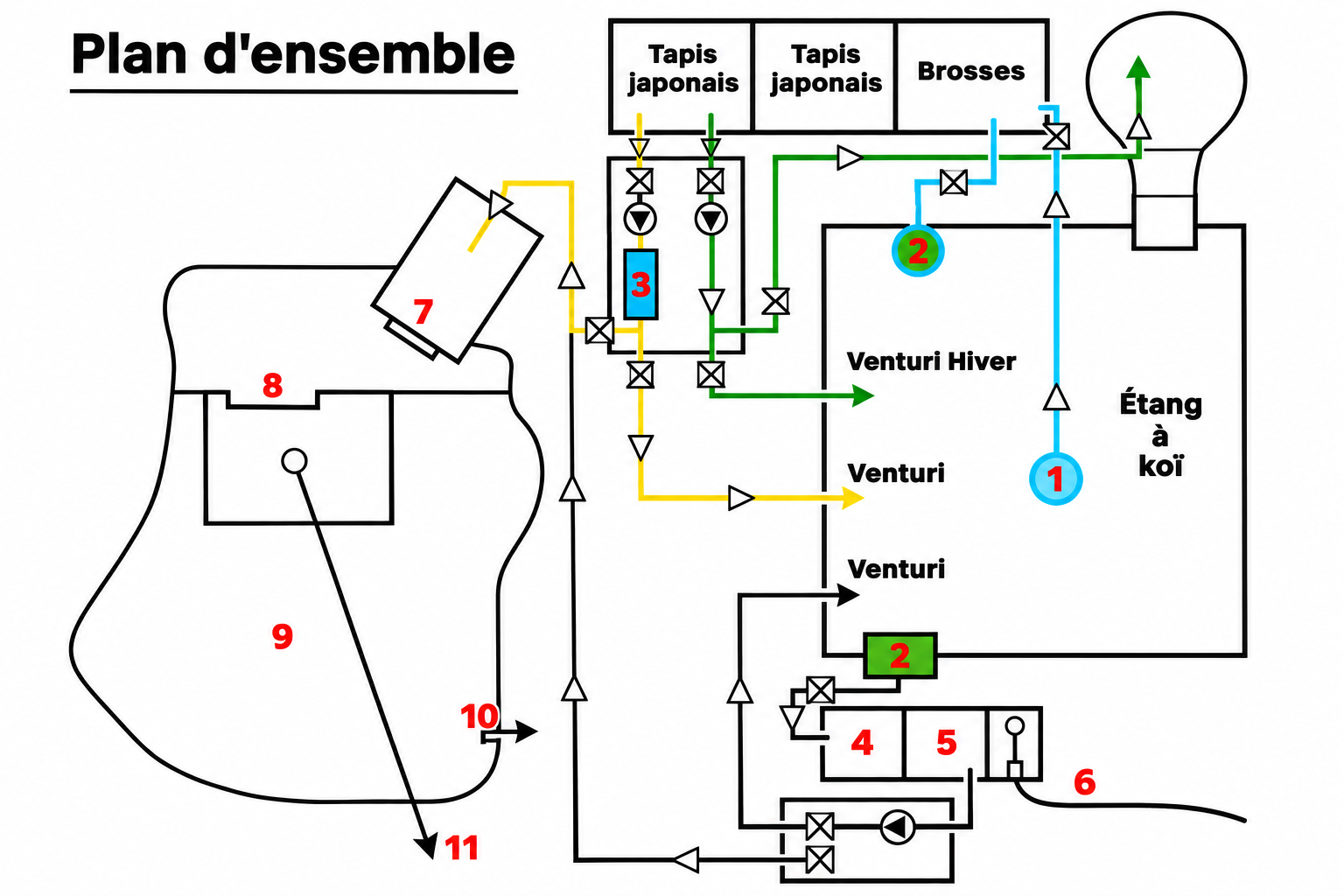
The plan brings together the circuits of the pond and the lagoon. The references are given in the explanations below.
From pond to gravity filter
All parts of the large pond: water can reach the filter by the bottom drain (1), the surface skimmer (2), especially in winter, or both.
The filter and pumping unit
The multi-chamber filter is filled with brushes in the first tank and Japanese filter matting in the following ones. It works in gravity and has therefore been placed on the same level as the pond. The pumping unit and the UV are located at the outlet of the filter (3). This group consists of two pumps of type stainless steel heating circulator, three speeds, a series of valves and a UV.
Isolating equipment
The pumping unit can be completely insulated by means of valves placed outside the unit, which also allow for the selection of operating circuits.
Divide water returns
The branch of the UV (3, yellow line) can feed the lagunage, one of the venturis of the pond, or both. The second branch (green line) feeds the cascade or a venturi in winter. The circulator is placed in a slow position during the cold period: it is one of the advantages of this type of material.
The second pumping group
The lagoon can be fed by the first pumping unit, but also by a second small group (4, 5 and 6). It has only one pump at a speed, always made of stainless steel. A mechanical prefiltration is carried out in the small filter (4 and 5). This box also includes an automatic filling system of the pond. It is indeed imperative to maintain a constant level, the two filters being at the level of the pond. The pumping unit is located in a separate housing and the whole is hidden under a hatch. We will return to this part of the assembly in the rest of the report.
Lagunage levels
The first level is fed by one of the pumping units. A larmal (7) then feeds the second level, located below. Larger, this level already allows plantations to be carried out. In turn, it overflows with a larmal (8) in the lower zone, which constitutes the main body of the lagunage (9). We will return to this particular mode of power supply.
Cross-washing and returning to the pond
The system is fitted with a backwash (11), which is directly connected to the drainage system. The overfilling of the lagoon is done at point 10 and returns directly to the large pond.
The rest of the report
If this pattern seems obscure to you, rest assured: we will develop each point in detail.