Michael's Lagunage — Cups and Operation
Part Four · The Water Route
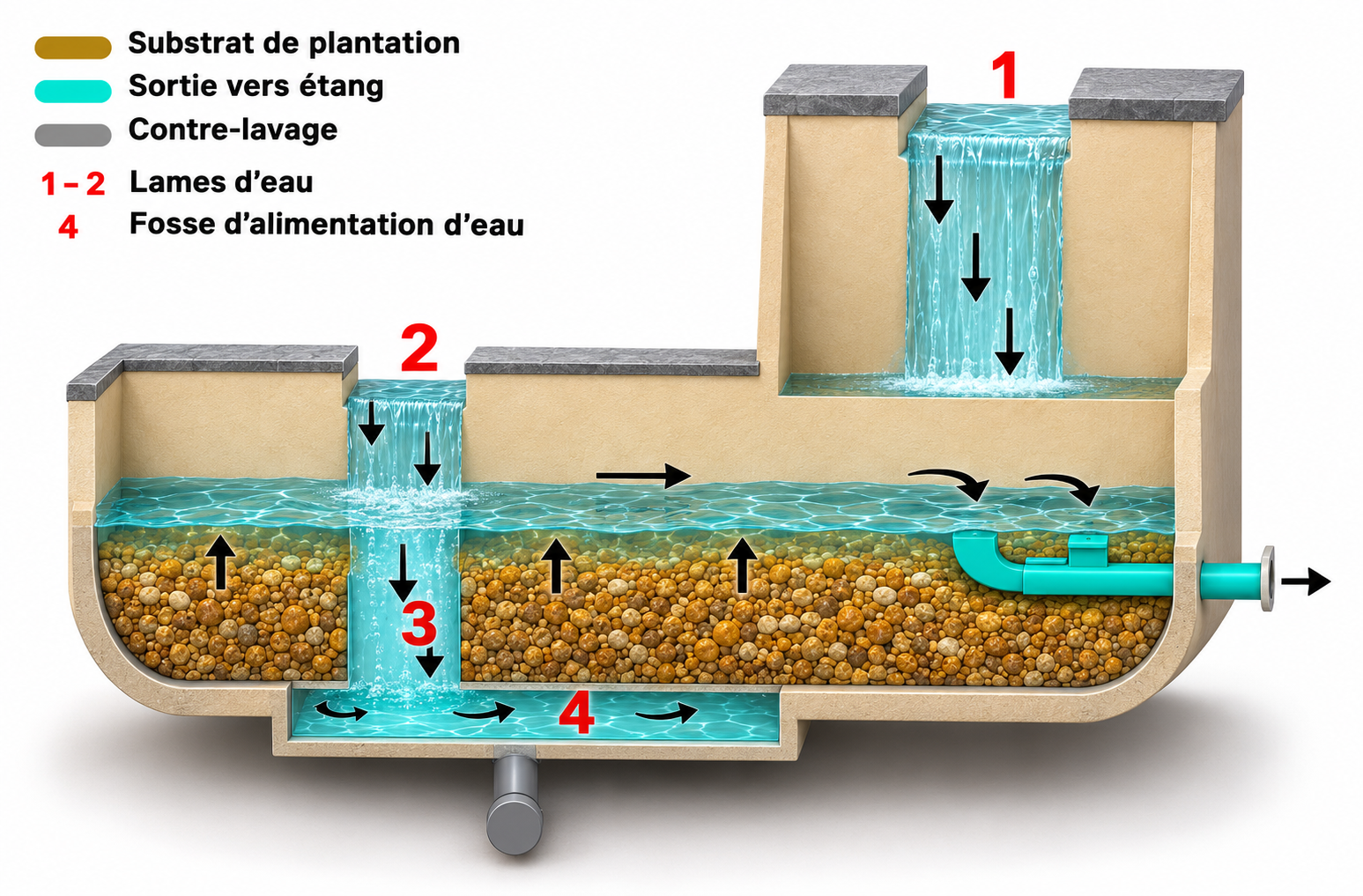
So this is the cup of our lagunage, the principle is simple:
From waterfalls to the first plantations
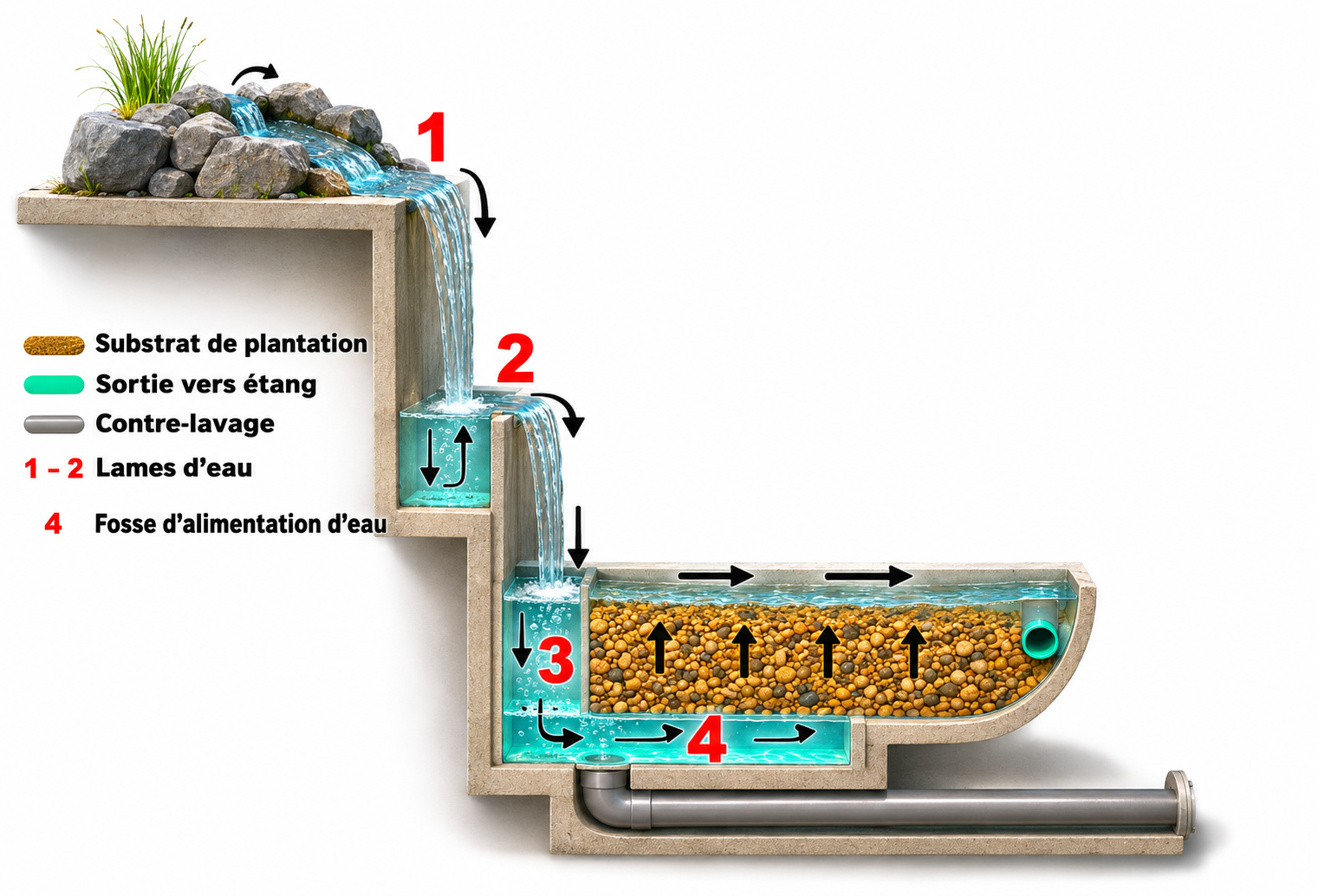
The water is brought into the first zone (1) and flows through a stone on a blue stone slab. The overflow, or larmal, feeds zone 2, which already hosts plantations.
Feeding under laguing and backwashing
Zone 2 overflows with a larval in a receptacle (3). It feeds the underside of the lagunage (4), which has a grid. This area serves as a settling chamber and helps to limit the obstruction of the lagonage. The grey pipe, at the bottom, corresponds to the back-washing of the system. It allows to empty the settling zone by actuating a valve for a few seconds.
The return to the pond
The overflow and therefore the return to the main pond is at the other end of the lagunage.
Planting substrate
The lagoon is filled with lava stones, or puzzolan, to accommodate plantations. The water level is expected to be lower than that of the substrate in order to limit the development of algae in this part.
Water oxygenation
The two larmies promote oxygenation of water before entering the lagunage. This oxygen supply is essential for the proper development of aerobic bacteria.
Proceed to implementation
All that remains to be done is to carry out this project: the theory of "there is only"! Each point will be developed in detail. Don't hesitate to go back to the different patterns to understand the aspects of this realization.
A second view of the lagoon